
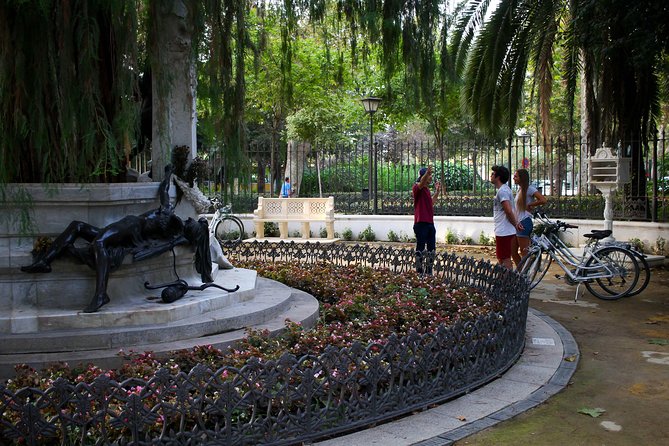
Review · SEVILLE
Sunset Guided Bike Tour in Seville
Seville reveals itself best at street level, and this three-hour bike ride gives you a quick, pleasant look at the city’s major sights without making you queue indoors. You’ll pedal through Santa Cruz, cross into Triana, follow the river, and finish among the grand squares and gardens near Plaza de España.
I like two things in particular: the easy pace with frequent stops, and the guides’ practical local advice. Daniel is praised for his humor, while Marta, Ivan, Laura, and Natalia are also singled out for warmth, city knowledge, and useful restaurant and flamenco tips. The main caution is timing. It is sold as a sunset tour, but the light and temperature depend on the date, and one booking did not feel like a sunset outing.
Key points to know before you book
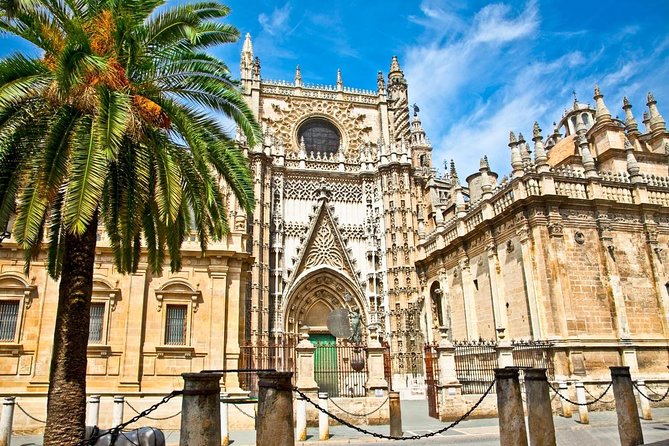
- A broad Seville overview: You see the cathedral, Alcázar, Torre del Oro, Triana, Plaza de España, María Luisa Park, and more in one outing.
- Relaxed cycling: The route includes short riding sections and regular stops, making the three hours feel less strenuous than the duration suggests.
- Strong guide element: Daniel, Marta, Ivan, Laura, and Natalia are frequently praised for humor, warmth, local stories, and clear explanations.
- Useful first-day activity: You receive a map with suggestions for restaurants, tapas, flamenco, and other things to do later.
- Small-group scale: The maximum is 15 people, though some departures are smaller.
- Good value for a city introduction: At $36.28, the price includes the bike, helmet, guide, and insurance, but not food or drinks.
Why a bicycle works so well in Seville
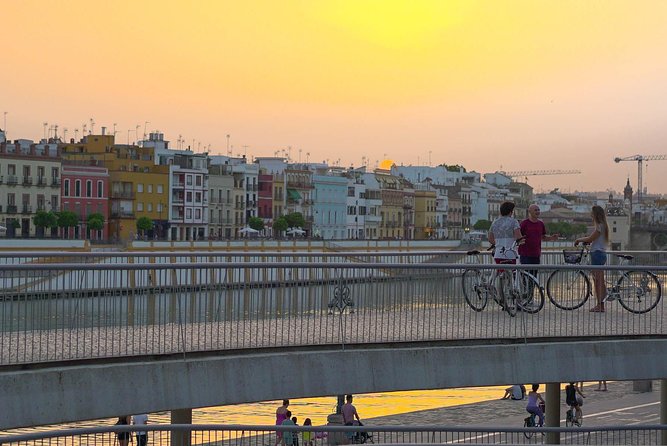
Seville’s center is full of short distances that can feel oddly long on foot. A bicycle lets you connect the cathedral, Santa Cruz, the river, Triana, and María Luisa Park in one continuous outing.
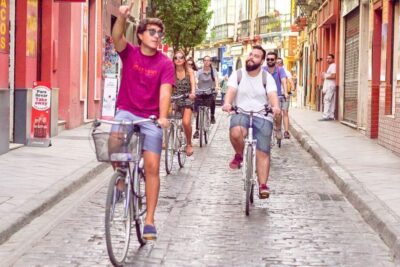
This is not a hard cycling challenge. The ride is described as gentle, with frequent pauses of two or three minutes for stories and photographs. The streets are generally flat, and the route uses bike-friendly areas and paths. Still, you should be comfortable riding a bicycle in an urban setting. One account describes the ride as suitable even for infrequent cyclists, while another notes that it may not be ideal for a complete novice.
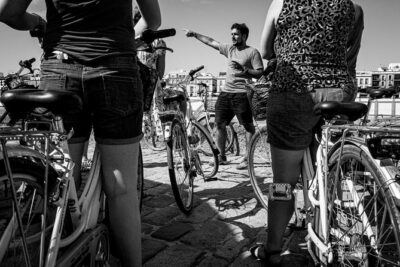
The regular stops are important. You are not expected to pedal for three straight hours, and the tour does not try to force every sight into a long lecture. You ride, stop, listen, look around, and move on. That rhythm keeps the outing social and prevents the city tour from becoming a tiring march through monuments.
The maximum group size is 15 people. That is large enough to create a friendly atmosphere but small enough for a guide to keep the group together. Some departures have been as small as six or eight people, which can allow extra time to wander near a stop.
More Sunset Bike Tours in Spain:
- Madrid at Night: Vintage Bike Tour of City Highlights
★ 4.9 · 95 reviews - Barcelona Bike Tour by Night with Cava
★ 4.9 · 40 reviews - Cordoba at Night by Bike, Electric Bike
★ 4.6 · 24 reviews
From the cathedral to Santa Cruz
The meeting point is SeeByBike at Mercado del Arenal, on Calle Pastor y Landero, near the historic center. From there, the route heads toward Seville Cathedral, one of the city’s defining sights and the largest Gothic cathedral in the world.
You view the cathedral from outside rather than touring the interior. That is a limitation if you want to see the tomb of Christopher Columbus, the chapels, or the building’s full scale from within. It is also a sensible choice for a three-hour overview, since an indoor visit would take a large part of the tour and may involve a line.
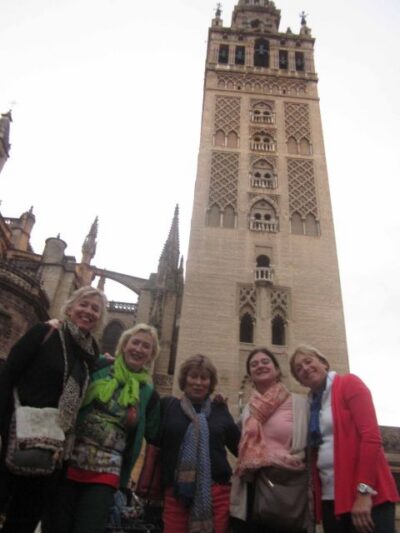
The nearby Giralda gets its own stop. This tall bell tower began as the minaret of Seville’s Great Mosque during the period of al-Andalus. Its shape helps explain the city’s layered character, with Islamic, Christian, Mudéjar, Gothic, and Renaissance influences appearing within a few minutes of one another.
Next comes Barrio Santa Cruz, the old Jewish quarter and one of Seville’s most atmospheric areas. Its narrow lanes, small squares, and twisting routes are far easier to understand with a guide than from a map. A bicycle also helps you cover the surrounding streets without spending your entire afternoon trying to find your way out.
The tour pauses at the Real Alcázar, again from the exterior. This royal palace combines Moorish, Gothic, Mudéjar, and Renaissance design. You will get context and a chance to see the outside, but the gardens and palace rooms require a separate ticket and visit.
I like this opening section for first-time visitors because it gives you a useful mental map. Afterward, you know where the cathedral, Giralda, Alcázar, and Santa Cruz sit in relation to one another. You can then return on foot to the places that deserve more time.
Along the river to the Torre del Oro
The route continues toward the Torre del Oro, the golden tower beside the river. Built in the 13th century to help control access to Seville’s port, it is one of the city’s most recognizable landmarks.
This is a good place to appreciate the value of riding instead of walking. The riverfront connects several major areas, and the bicycle makes the transition feel natural. You are not simply checking off a tower. You are seeing how the water, port, old center, and Triana district fit together.
The tour does not include food or drinks, but the stop pattern can leave room for a brief refreshment break depending on the group and guide. One long account mentions time for a coffee or Aperol spritz. Treat that as a possibility, not a guaranteed inclusion. Any purchase is your responsibility.
Crossing into Triana
Triana has a distinct identity from the old center. The neighborhood is linked with pottery and tile production, flamenco, and its own local festivals. The bike tour uses Triana to show a different side of Seville, one that is less focused on royal buildings and more tied to neighborhood life and craft traditions.
The route gives you about 20 minutes in the area. That is enough to get a feel for its streets and hear why Triana matters, but not enough for a detailed pottery workshop, market visit, or flamenco performance. You should see this part as an introduction and return later if you want to explore at a slower pace.
This section also suits solo visitors. The group setting is social without requiring you to arrange a separate companion, and the guide can point you toward places to eat or see flamenco after the ride. Ivan is especially praised for sharing local recommendations and helping people plan the rest of their stay.
More guided departures in Spain:
- Highlights & Hidden Spots of Barcelona Bike Tour w/ Local Guide
★ 4.5 · 3,009 reviews - Valencia: City Highlights Guided Bike Tour
★ 4.7 · 2,373 reviews - Madrid: 3 h. Guided Highlights Bike Tour with Optional Tapas
★ 4.9 · 1,623 reviews - Seville: Relaxing City Bike Tour with a Tour Guide
★ 4.8 · 1,588 reviews
Plaza de España and María Luisa Park
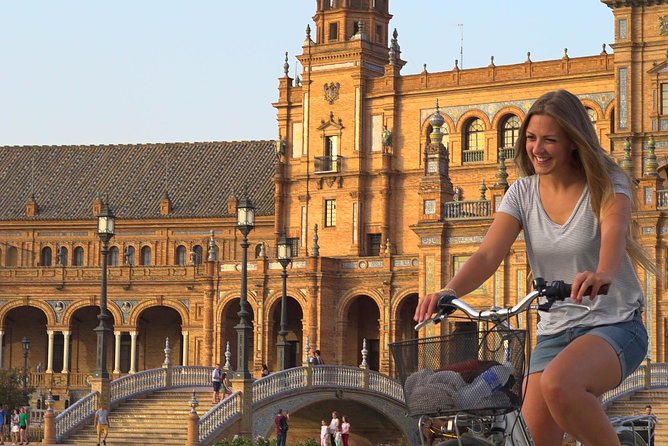
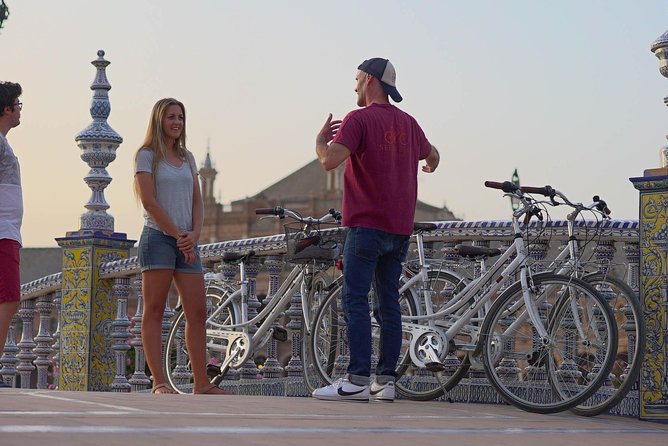
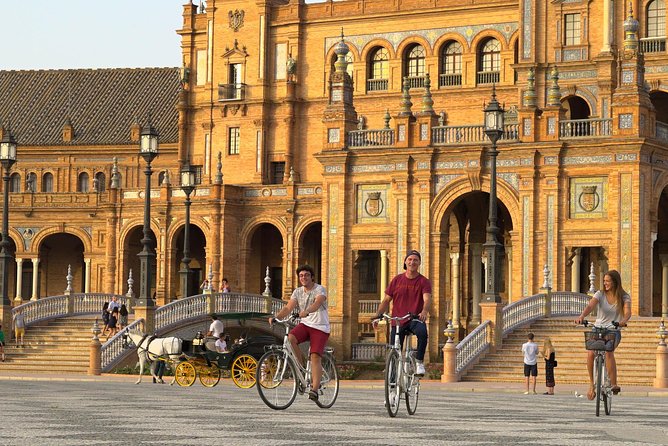
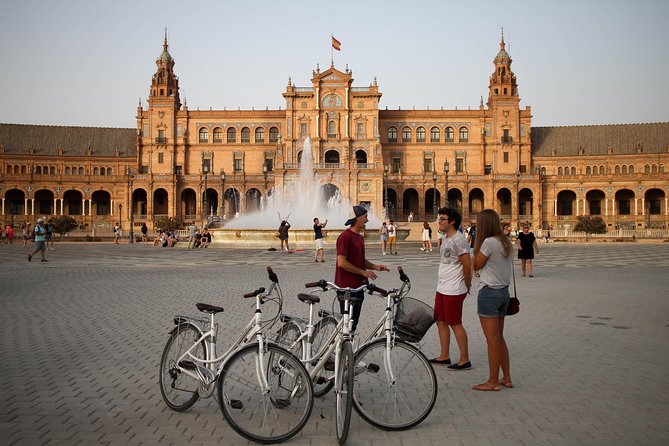
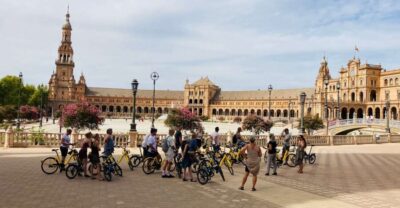
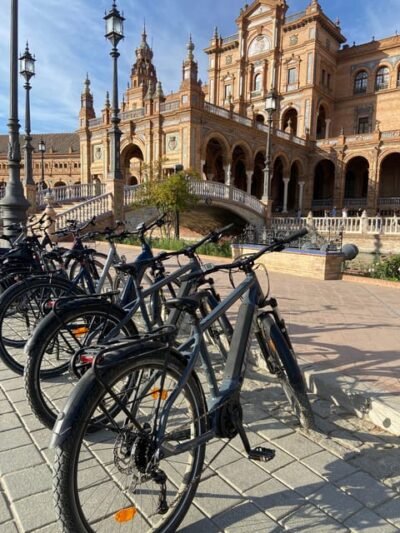
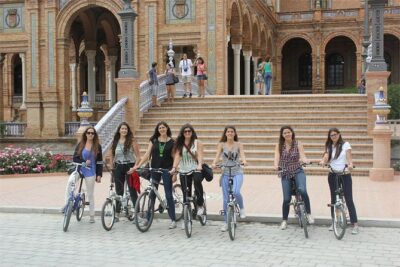
Plaza de España is likely to be the visual high point of the ride. Built for the Ibero-American Exhibition of 1929, the huge semicircular complex combines tiled decoration, bridges, water, and grand architecture. The 20-minute stop gives you time to look around and take photographs.
Do not confuse this with a quick pass-by. The plaza is one of the few stops where you are likely to want extra time after the tour. The bicycle outing introduces it, but a separate return visit lets you examine the tiled provincial alcoves and arcades without worrying about keeping up with a group.
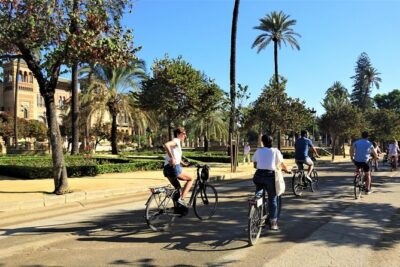
Next to the plaza, Parque de María Luisa provides a welcome change from stone streets. Shady paths, exotic trees, tiled benches, Moorish-style fountains, and fairytale-like buildings give the park a softer feel. Cycling through it is one of the strongest reasons to choose this tour over a bus route.
The route also includes Plaza de América, another part of the 1929 exhibition grounds. It is framed by the Museum of Popular Arts, the Archaeological Museum, and the Royal Pavilion, each built in a different architectural style. You see the area from outside, with about 10 minutes to take in the layout.
The Real Fábrica de Tabacos is another revealing stop. Once Europe’s most important tobacco factory, it now houses the University of Seville. The schedule allows time to look inside, though this should not be mistaken for a full university or museum tour.
Santa Ana, San Telmo, and the final stops
In Triana, the Iglesia de Santa Ana adds a religious and architectural stop to the neighborhood visit. Dating to 1276, it is one of Seville’s oldest churches and uses a Gothic-Mudéjar design, with a vaulted interior and religious decoration.
The listed stop lasts about 10 minutes. That is enough for a concise explanation and a look inside if access is available, but not a long examination of every detail. The mix of church, pottery district, river, and flamenco traditions gives Triana more depth than a simple photo stop.
Back near the center, the route includes the Palau de San Telmo, one of Seville’s finest Baroque buildings. It began as the seat of the University of Navigators, an apt connection for a city shaped by river trade and ocean travel.
The full route also includes exterior views of the cathedral, Alcázar, Torre del Oro, and Giralda. Since several major monuments are visited from outside, you should book this as a city orientation, not as a replacement for interior sightseeing.
The guides make the difference
The guide is the part of this experience you cannot predict as precisely as the route. Daniel receives especially strong praise for lively stories, humor, language skills, and an ability to keep an international group involved. His recommendations after the tour have included La Parrala, a local spot that impressed one couple.
Marta is described as passionate about Seville and especially good at making people feel they have a friend in town. She also handled a group of less frequent cyclists at a comfortable pace. Ivan is repeatedly praised for his humor, local affection, historical explanations, and tapas suggestions. Laura is noted for keeping a relaxed pace and including the whole group.
Natalia is also described as friendly and engaging. The practical lesson is simple: the guide can shape the mood and quality of the ride. The route is worthwhile on its own, but a warm storyteller turns the stops into a connected account of Seville instead of a list of buildings.
You should also feel free to ask questions. The guides are praised for answering them and for sharing advice about food, flamenco, and later sightseeing. The included map is useful because it turns the tour into a planning tool for the rest of your visit.
Sunset timing, heat, and comfort
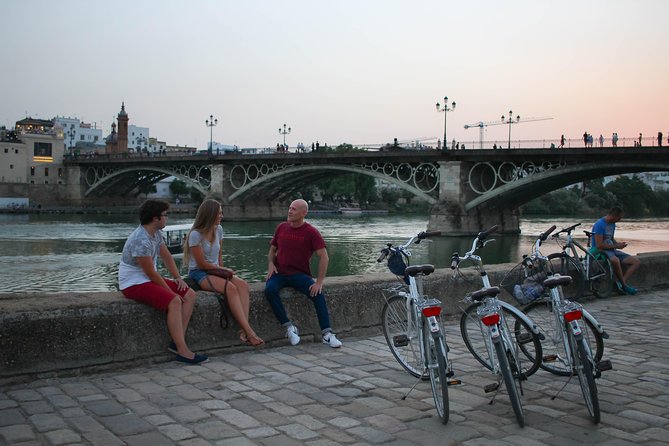
The sunset label deserves a little care. An evening departure can make Seville feel calmer and less hot, and several people enjoyed cycling through the city in the softer light. But sunset varies with the season, and at least one departure did not feel like sunset at all.
If you are booking mainly for golden-hour photographs, check the exact start time against sunset on your date. If your priority is avoiding the worst heat, ask about scheduling when you arrive in Seville. One August booking was moved to the morning because of high temperatures, and that change was appreciated.
The bikes are considered good or adequate, though one rider found the bike old. Helmets, insurance, and the bike are included. You should wear comfortable clothing, bring water for your own use, and expect to remain outdoors for most of the three hours. Food and drinks are not included.
Children must be accompanied by an adult. Most people can take part, but you should be confident enough on a bicycle to manage city streets and group riding. The tour is family-friendly, yet a very young child or a person who has not ridden in years may need a more careful assessment before booking.
What the $36.28 price delivers
At $36.28 per person, this is a fair price for a three-hour guided orientation. You are paying for the bike, helmet, insurance, guide, route planning, and local suggestions. If you tried to connect these districts alone, you could spend much of the day navigating instead of looking around.
The value is strongest on your first day in Seville. You see where to return, learn which neighborhoods suit your interests, and get food and flamenco suggestions while the city is still new to you.
The price is less compelling if you already know Seville well or plan to spend the entire day inside the cathedral and Alcázar. Since admission is not included and the major monuments are mainly exterior stops, you will still need separate tickets for the interiors.
The activity is generally booked about 26 days in advance, so it is sensible to reserve ahead during busy periods. A minimum of two people is required, and the maximum group size is 15. The meeting point is near public transportation, and the ride returns to the same Mercado del Arenal location.
Free cancellation is available until 24 hours before the start time. A cancellation inside that window is not refunded, and poor weather can lead to a new date or a full refund.
Who should book this ride?
I would choose it for a first or second day in Seville, especially if you want the city to make sense before tackling its major interiors. It suits couples, families with capable young riders, solo visitors, and anyone who prefers short stops to long guided lectures.
It is also a good match if you want local suggestions. The map and guide advice can save you from eating near the most obvious tourist streets or missing the city’s flamenco options.
I would think twice if you dislike cycling, struggle with urban riding, or want a detailed visit inside every monument. The tour is not designed for that. It is a moving introduction, with the best sights saved for later exploration.
Should you book the Sunset Guided Bike Tour?
Book it if you want a relaxed, efficient way to connect Seville’s old center, riverfront, Triana, Plaza de España, and María Luisa Park. The route is broad, the pace is gentle, and the guides add the humor and practical advice that make a first city visit easier.
Book with realistic expectations about sunset timing and indoor access. The best version of this experience is a three-hour orientation with a good storyteller, not a full monument tour. If Daniel, Marta, Ivan, Laura, or Natalia is leading your departure, expect a personable guide, but remember that the exact guide is not guaranteed.
FAQ
How long does the bike tour last?
The tour lasts approximately three hours.
Where does the tour begin?
It begins at SeeByBike in Mercado del Arenal, C. Pastor y Landero, 4, in Seville’s Casco Antiguo.
Where does the tour end?
The tour ends back at the same meeting point.
Is the bicycle included?
Yes. The bike, helmet, guide, and insurance are included.
Are food and drinks included?
No. Food and drinks are not included in the tour price.
Is the tour offered in English?
Yes. The activity is offered in English.
What is the maximum group size?
The maximum group size is 15 people.
Can children join the tour?
Yes. Children can participate, but they must be accompanied by an adult.
Does the tour enter the cathedral and Alcázar?
The scheduled stops at the cathedral and Alcázar are exterior visits. The route allows time to look inside the Real Fábrica de Tabacos.
What happens if the weather is poor?
If poor weather causes the tour to be canceled, you are offered another date or a full refund. You can also cancel for a full refund if you do so at least 24 hours before the start time.
New rides added around Spain
- Penedès/BCN: Self-Guided eBike Tour with guided Winery Visit★ 5.0 · 19 reviews
- Barcelona | StreetArt Bike Tour Moco Museum★ 4.6 · 13 reviews
- Maspalomas: Rent 4 or 8 hours untill 7-Day Mountain Bike★ 4.5 · 14 reviews
- Maspalomas: Southern Coast E-Bike Tour Option Tapas Tasting★ 4.8 · 14 reviews
- Mallorca: Touring or electric bike rental in Cala Millor★ 5.0 · 22 reviews
- Málaga E-Bike Tour with Full Day Rental★ 4.2 · 54 reviews
- Rent a bike in Malaga★ 4.5 · 84 reviews
- Malaga: City Bike Rental with Self-Guided Cycling Route★ 4.7 · 21 reviews
Seville Bike Tours, compared.
Browse the lists this tour appears in