
Review · MILAN
Highlights and hidden gems of Milan Bike Tour
Milan’s best feature is its mix of old and new, and this tour connects both by bicycle. In just over three hours, you pedal from Roman ruins and a medieval fortress to fashion streets, modern towers, and the Duomo. I like the wide view of the city and the way guides such as Paolo, Sandra, Angelo, and Marco add local stories at each stop.
I also like the easy pace and useful orientation. You cover much more ground than on foot, making this a smart first-day activity. The catch is Milan’s riding surface: cobblestones, brick paths, narrow streets, cars, and pedestrians can make the ride less smooth than expected. You should be comfortable on a bike, and larger groups can feel crowded in busy areas.
Key points to know before booking
- See old and new Milan in one ride: Roman ruins, La Scala, the Duomo, Sforza Castle, Porta Nuova, and Bosco Verticale all fit into the route.
- The tour covers serious ground: It is a strong way to get your bearings if you have only a short stay.
- Guides shape the experience: Paolo, Sandra, Angelo, Marco, and Simone are praised for clear storytelling, safety, and friendly help.
- The standard bikes are simple: Classic Dutch-style bikes are included, and some are one-speed models. E-bikes cost an additional €15 when available.
- Expect mixed road surfaces: Milan’s cobbles, bricks, narrow lanes, and pedestrian areas require steady bike skills.
- The price is fair for the coverage: At $47.16 per person, you get a guided ride, bike, helmet, and a broad city introduction.
Why a bike is a smart way to see Milan
Milan is large enough that walking between its main districts takes time, but compact enough for a bike route to link them in one morning. This tour uses that advantage well. You move from the ancient Ticinese area to the Gothic Duomo, then across historic neighborhoods and newer business districts.
I like this approach because Milan is not a city where every important sight sits around one square. Its character is spread across several areas. The ride gives you a useful map in your head: old center here, artistic Brera there, grand castle farther north, modern Porta Nuova beyond it, and the canals and Roman remains back toward Ticinese.
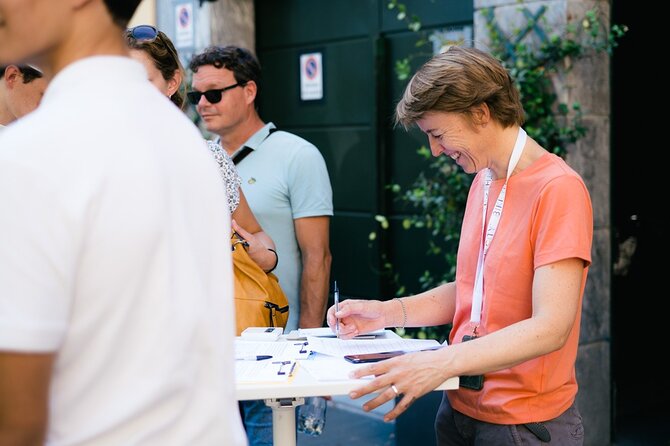
The tour begins at 10:00 a.m. on Via Vetere, 11, in the Porta Ticinese area. The meeting point is close to public transportation, which helps if you are staying outside the historic core. After a short safety briefing, you receive a bike and helmet before setting off.
The route is guided rather than rushed. You stop for photos and short explanations, but this is not a museum tour with long interior visits. The main value comes from seeing the city’s streets and landmarks in sequence.
More City Bike Tours in Italy
- Rome: Top Highlights & Hidden Gems Tour by Cannondale E-Bike
★ 4.9 · 1,760 reviews - Florence: 2-Hour Guided Sightseeing Bike Tour
★ 4.5 · 1,004 reviews - Naples: City Highlights Guided Bike Tour
★ 4.7 · 850 reviews
Porta Ticinese sets the tone
The opening stop is Porta Ticinese, an old and bohemian part of Milan whose name comes from the historic city gate. It is a useful starting point because the tour begins with a neighborhood rather than a single famous monument.
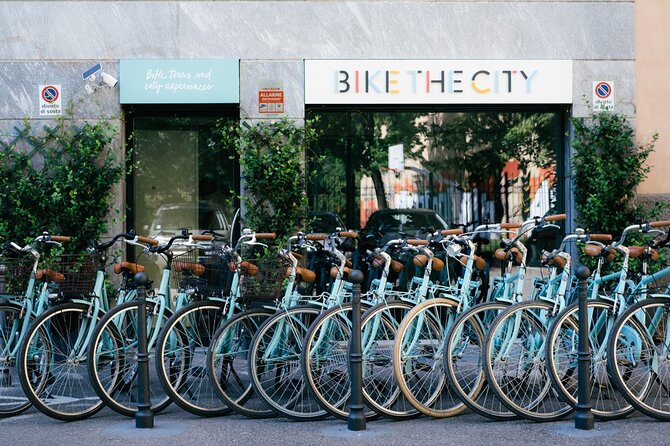
You ride a classic Dutch-style bike from here. These bikes are described as comfortable and in good condition, though some are basic one-speed models. That is enough for a mostly manageable urban route, but you should not expect a sporty bicycle with many gears.
The first section helps you settle into the group and the city traffic. Pay attention during the safety briefing, especially if you are not used to riding around pedestrians or along narrow streets. The route is not described as strenuous, yet road conditions can make certain stretches feel bumpy.
The Duomo and Milan’s grand center
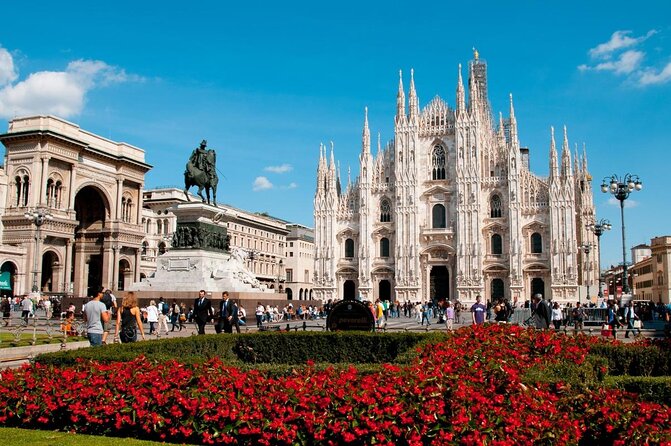
The Duomo stop gives you one of the tour’s longest pauses, about 20 minutes. You see Milan’s famous Gothic cathedral, along with the Royal Palace, the Museo del Novecento, and the Galleria Vittorio Emanuele II.
A bike tour cannot replace time inside the cathedral or the art museum, but it gives you the setting and historical connection between them. The Duomo is not an isolated church. It sits at the heart of Milan’s political, artistic, and commercial center, and the nearby buildings help explain why this square matters.
This is also a good photo stop. You can take in the cathedral’s elaborate exterior while the guide explains its construction and place in the city. If you want to visit the Duomo interior or roof terraces, plan that separately. The tour only includes an exterior visit.
La Scala and the polished side of Milan
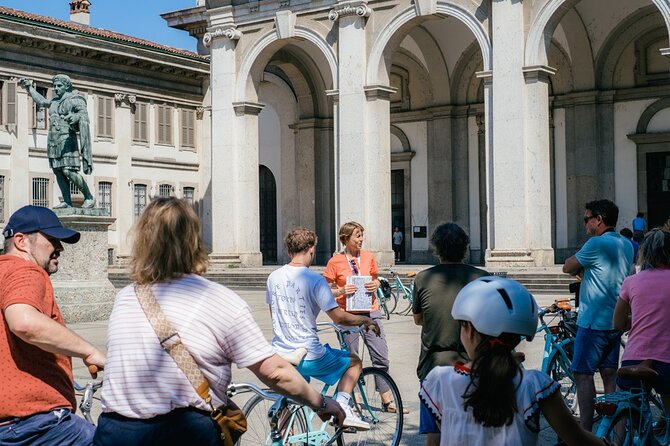
From the Duomo, you pedal to Piazza della Scala. The stop at Teatro alla Scala is short, about five minutes, but the opera house carries plenty of weight. The guide covers the singers, conductors, and stories linked to this famous stage.
You see La Scala from outside, so this part works best as a quick orientation stop rather than a full cultural visit. I like the contrast: a few minutes earlier you were facing a vast Gothic cathedral, and now you are looking at one of the world’s best-known opera houses.
The surrounding streets lead toward Milan’s polished fashion districts. Earlier in the ride, the route passes the gardens around Palestro and the Manzoni district, known for luxury buildings and fashion headquarters. This gives you a look at the city’s high-end side without turning the tour into a shopping trip.
Same wheels, a different route:
- Rome EBike Tour: Appian Way, Catacombs & Roman Aqueducts
★ 5.0 · 1,766 reviews - Rome: Appian Way & Aqueducts E-Bike Tour (Catacombs & Food)
★ 4.9 · 1,498 reviews - Rome: Appian Way, Catacombs, & Roman Aqueducts E-bike Tour
★ 4.9 · 1,421 reviews - Rome City Small Group Bike Tour with quality Cannondale EBike
★ 5.0 · 1,380 reviews
Brera brings art and old streets together
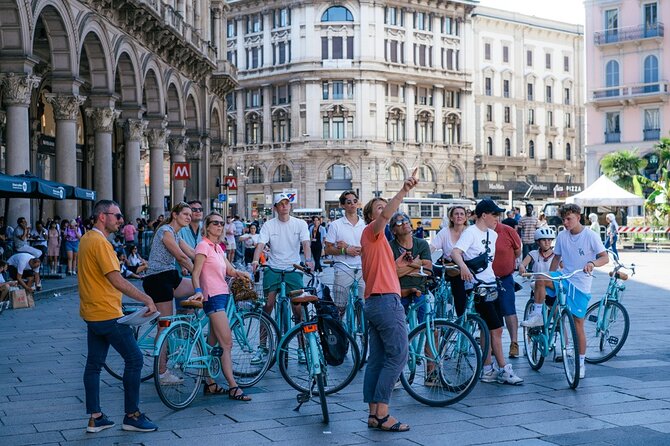
Brera is one of the route’s most appealing sections. Its narrow streets are lined with older Milanese houses, churches, small workshops, and the Pinacoteca di Brera, the city’s major art gallery.
You do not enter the gallery during the ride, but the neighborhood itself rewards a slower look. Brera feels more intimate than the grand spaces around the Duomo. This is where you see the kind of street-level Milan that is easy to miss if you only visit headline attractions.
The stop lasts about 15 minutes. That is enough for an explanation and a short pause, but not enough for a detailed art visit or a long café break. If Brera catches your interest, mark it on your map and return later on foot.
Porta Nuova shows Milan’s modern face
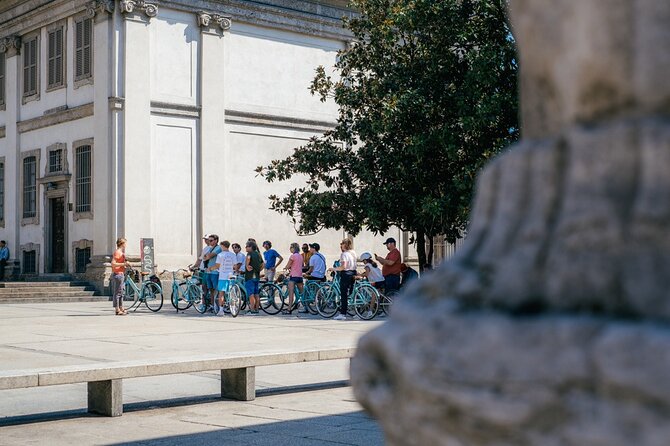
The route then changes mood in Porta Nuova. Here, older buildings give way to newer architecture, including Palazzo Lombardia, the Biblioteca degli Alberi, the Unicredit Tower, and Bosco Verticale.
This is one of the tour’s most useful contrasts. Milan is not only a city of cathedrals, opera, and old stone. It is also a center of modern design and business, and Porta Nuova makes that clear in a few blocks.
Architecture fans will get the most from this section. You see how the city has developed a new skyline while keeping its older districts close by. The stop lasts about 15 minutes, giving you time to look upward and take photos without losing the route’s pace.
Sforza Castle is the major historical pause
Sforza Castle receives about 25 minutes, the longest stop on the route. This imposing fortress began as a stronghold and became tied to Milan’s ruling family during the late medieval and Renaissance periods.
The guide explains how the castle was built for the first duke of Milan in the 14th century and how major architects and designers, including Leonardo da Vinci, worked in Milan under Ludovico il Moro. That connection gives the castle more meaning than a quick photo stop. It was not simply a defensive wall. It became part of the political and artistic life of the city.
You enter the castle courtyards, not the full museum collection. That is a sensible choice for a city overview, since an interior visit would take far longer than the schedule allows. If you want to explore the castle museums, return on another day.
The transition from central streets into the castle area also gives the ride a sense of progress. You have moved beyond the busiest shopping and cathedral zone and reached one of Milan’s strongest historic landmarks.
Parco Sempione offers a needed breather
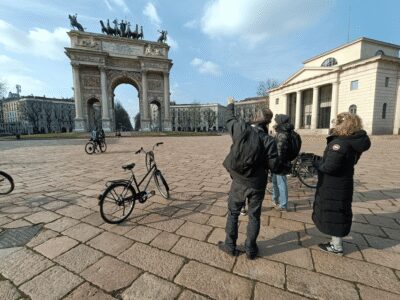
After the castle, the group slows down in Parco Sempione, Milan’s large central park. The park is home to the neoclassical Peace Arch, and the route allows about 10 minutes here.
This pause matters. Three hours on a bike is not difficult for most riders who are used to cycling, but the combination of traffic, cobbles, and frequent stops can still be tiring. A green space gives you a chance to stretch, drink water, and reset before the final section.
The timing of the break can vary. If the tour begins late because of delayed arrivals, the rest may be shortened. Arrive early at the meeting point so you do not lose part of the pause or force the group to compress later stops.
Roman Milan returns you to Ticinese
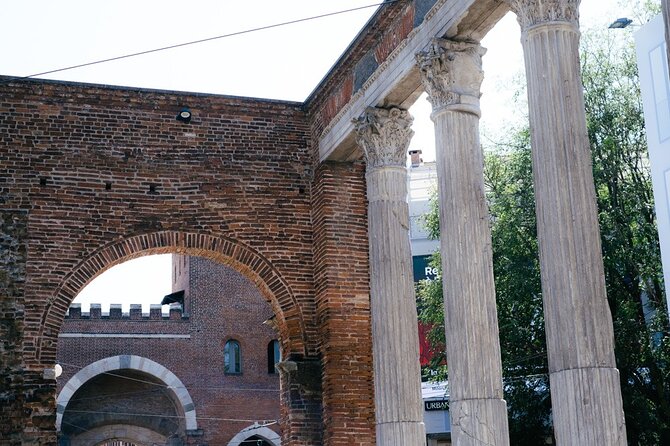
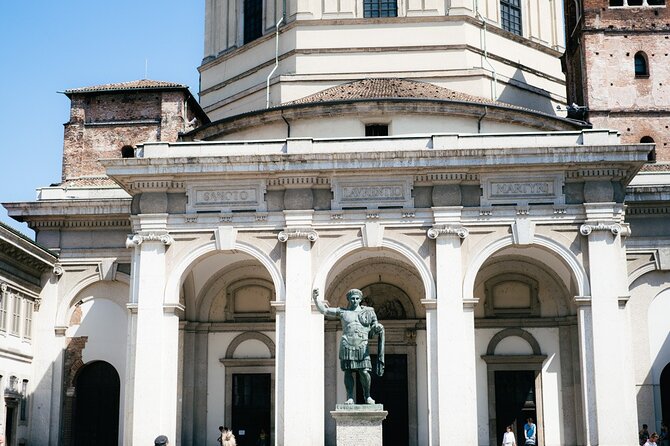
The final major stop is Colonne di San Lorenzo, reached before returning to the starting point. These columns and nearby remains recall the period when Milan was an important Roman capital, with a palace, circus, and amphitheater in the area.
This is a strong ending because it adds an older layer to a route that has already shown medieval, Renaissance, 19th-century, and modern Milan. The stop lasts about 15 minutes, enough for the guide to explain the ruins and their place in the city.
You finish back at Via Vetere. The route’s return to the Ticinese area makes the morning practical: you can continue exploring the neighborhood, find lunch, or use public transportation from there.
Guides are a major part of the value
The tour’s strongest feature is the guide. Paolo is repeatedly praised for his history explanations, friendly manner, and ability to answer questions. Sandra is noted for keeping family groups safe and for making water and shade stops when the day becomes warm.
Angelo is praised for combining safety with clear explanations, while Marco and Simone are also singled out for giving useful introductions to the city. Guide quality can vary from date to date, but the company uses several named guides, so the tone may differ slightly between departures.
A good guide matters more on a bike tour than on a simple transfer. You need someone who can keep the group together, choose safe places to pause, and explain a sight without making everyone stand around too long. The best feedback points to exactly those strengths.
There is one caution: English may be harder to follow with some guides. If you miss a detail while riding, ask at the next stop. The tour is built around spoken explanations, so being willing to ask questions improves the experience.
Bikes, traffic, and group size
The standard bike and helmet are included. Some bikes have bags for carrying personal items, which is useful if you are not traveling light. E-bikes may be available for an additional €15 per person, but they are not guaranteed.
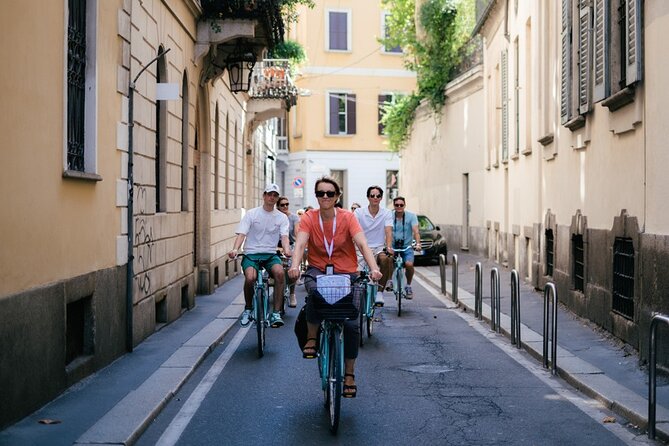
The route is generally described as easy and not too strenuous. Still, easy does not mean effortless. You ride near traffic, along narrow streets, across cobblestones and brick surfaces, and through areas with many pedestrians. One particularly important point is that even some bike paths may not be smoothly paved.
Group size can reach 30 people, though one reported departure had 14 riders. A group of that size can feel awkward in pedestrian areas, especially when everyone must stop or wait for the last rider. If you prefer quiet streets and a small private outing, this is not the right format.
Families can do well here. The minimum age is nine, and children between 135 and 155 centimeters tall need a suitable bike reserved by email. Availability is limited, so do not leave that request until the morning of the tour.
Is $47.16 good value?
At $47.16 per person, the tour is fairly priced for a guided ride lasting about three hours and 15 minutes. The price includes the bicycle, helmet, guide, and a route that reaches far more districts than most walking tours can cover in the same time.
You are paying for orientation and context rather than admission tickets. The main sights are seen from outside, and the castle visit is limited to the courtyards. That keeps the price down, but you will need separate tickets if you want to enter the Duomo, La Scala, the Brera gallery, or the castle museums.
I see the best value for a first day in Milan. After one morning, you know which neighborhoods deserve more time. The tour also helps if you have only 24 to 48 hours in the city and want a broad introduction without spending the whole day on foot.
Who should book this ride?
I would choose this tour if you are comfortable cycling and want history, architecture, and city orientation in one outing. It suits couples, families with older children, and solo visitors who want a lively way to see Milan’s main districts.
It is especially useful for a short stay. You can use the ride to decide where to return later, perhaps Brera for art and streets, the Duomo for an interior visit, or Sforza Castle for its museums.
I would think twice if you dislike riding near cars, feel uneasy on uneven pavement, or want long breaks at each sight. The route is broad rather than slow. You see many places, but you do not spend a long time inside any one of them.
The tour needs good weather and may be canceled if the minimum number of participants is not reached. You receive a different date or a full refund in those cases. You can also cancel for a full refund up to 24 hours before the 10:00 a.m. start.
Should you book the Highlights and Hidden Gems of Milan Bike Tour?
Yes, if your goal is to get your bearings fast and see Milan’s old and new sides in a single morning. The route is varied, the price is reasonable, and the guides add the context that makes the sights easier to understand.
Book it early in your stay, arrive ready to ride, and reserve a suitable child’s bike in advance if needed. Choose the tour with realistic expectations: it is a city overview on two wheels, not a series of long museum visits. For most confident cyclists, that broad view is exactly what makes the experience worthwhile.
FAQ
How long is the Milan bike tour?
The tour lasts approximately 3 hours and 15 minutes, beginning at 10:00 a.m. and ending back at the meeting point.
What is included in the tour price?
The price includes bike rental and a helmet. E-bikes are not included and may be available for an additional €15 per person.
Where does the tour begin and end?
The tour begins at Via Vetere, 11, 20123 Milano MI, Italy, in the Porta Ticinese area. It ends back at the same meeting point.
What age must children be to join?
The minimum age is nine. Children between 135 and 155 centimeters tall need a suitable bike reserved by email, and availability is limited.
How many people can join the tour?
The maximum group size is 30 people. The actual number on a departure can be smaller.
What happens if the weather is poor?
The tour requires good weather. If it is canceled because of poor weather, you can choose another date or receive a full refund.
New rides added around Italy
- Porto Torres: rent a water bike★ 4.9 · 18 reviews
- Pisa: Self-Guided Bike Tour to Lucca★ 4.9 · 28 reviews
- Pisa: Historic Center Tour by Bike Self-Guided★ 4.4 · 68 reviews
- Pisa: Cycling to the Sea on a Self-Guided Tour★ 4.7 · 46 reviews
- Pisa: Self-Guided tour to the sea by E-Bike★ 4.9 · 45 reviews
- Peschiera del Garda: Lake Garda & Borghetto E-Bike Tour★ 5.0 · 23 reviews
- Palermo: Anti-mafia Bike Tour★ 4.9 · 28 reviews
- Palermo: Historic Center Guided Bike Tour with Food Tasting★ 4.7 · 85 reviews
Milan Bike Tours, compared.
Milan’s Hidden Gems: Unique Bike Tour (ENG, NL)
Read our review →
Browse the lists this tour appears in