
Review · BUDAPEST
Budapest: Guided City Discovery Bike Tour
Budapest makes excellent sense from a bicycle seat. In 2.5 hours, you can connect grand Parliament, the Danube, Andrassy Avenue, Heroes Square, City Park, the Opera House, and the Jewish Quarter without wearing out your shoes. The route stays mostly flat on the Pest side, and guides such as Sam, Laszlo, Veronica, Ward, and Marcel are known for mixing local stories with clear riding help.
I like two things here: you cover far more ground than on foot, and the guides adjust the conversation to the group. Veronica has worked guests’ requested historic stops into the route, while other guides have added extra sights when time and interest allowed. I also like the small-group feel reported on many departures, including groups of three and five.
The main consideration is that this is an orientation ride, not a series of long museum visits. You usually stop for a few minutes, take photos, hear the key story, and keep moving. Helmets and bikes are included in the activity details, though one rider said a helmet was not offered, so confirm the fitting at the start.
Key points at a glance
- A flat Pest-side route: The ride is suitable for many casual cyclists and does not require an e-bike according to multiple riders.
- Major sights in one sweep: Parliament, Shoes on the Danube Bank, Heroes Square, City Park, the Opera House, Chain Bridge, and the Jewish Quarter all feature.
- Guides who tell stories, not just dates: Sam, Laszlo, Veronica, and others bring in politics, culture, local life, and useful evening suggestions.
- Good city orientation: You see where the main districts and attractions sit before deciding what deserves more time later.
- Healthy and low-impact sightseeing: Cycling gives you a closer view than a vehicle while saving time between distant sights.
- Strong reported value: At $38 per person, the tour combines equipment, a personal guide, and a broad introduction to Budapest.
Why a bicycle works so well in Budapest
Budapest is split by the Danube, with hilly Buda on one side and flatter Pest on the other. This tour concentrates much of its riding on Pest, which explains why several riders found the route easy and manageable. You are not signing up for a hill-climbing workout.
That matters because the city’s main sights are spread out. Parliament sits by the river, Heroes Square is farther out along Andrassy Avenue, and City Park lies beyond the grand central boulevards. On foot, connecting these places takes time. By bike, you can see the broad shape of the city and still have energy for a thermal bath, market, museum, or evening meal.
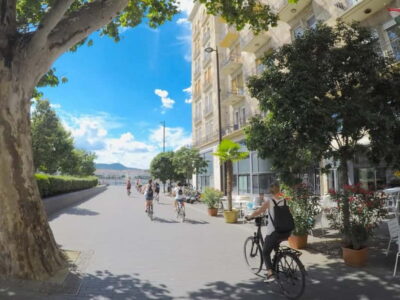
The pace is described as relaxed rather than sporty. You will ride through bike lanes and along busy roads, with the guide leading and calling attention to traffic lights, rough patches, and turns. If you are an inexperienced cyclist, the activity information says the tour is not suitable for children under eight, but several adults with ordinary fitness found the riding comfortable.
This is still city cycling. You should be happy starting, stopping, and riding near traffic. The guide’s job is to keep the group together, but you remain responsible for controlling your bike and following local signals.
More guided departures in Budapest:
- Budapest: Guided Downtown Electric Bike Tour
★ 4.9 · 595 reviews - Budapest: Monster Bike Roller Guided City Tour
★ 5.0 · 538 reviews - Budapest: E-Bike Guided Tour and Castle Hill
★ 4.9 · 241 reviews
Liberty Square and the first look at modern Hungary
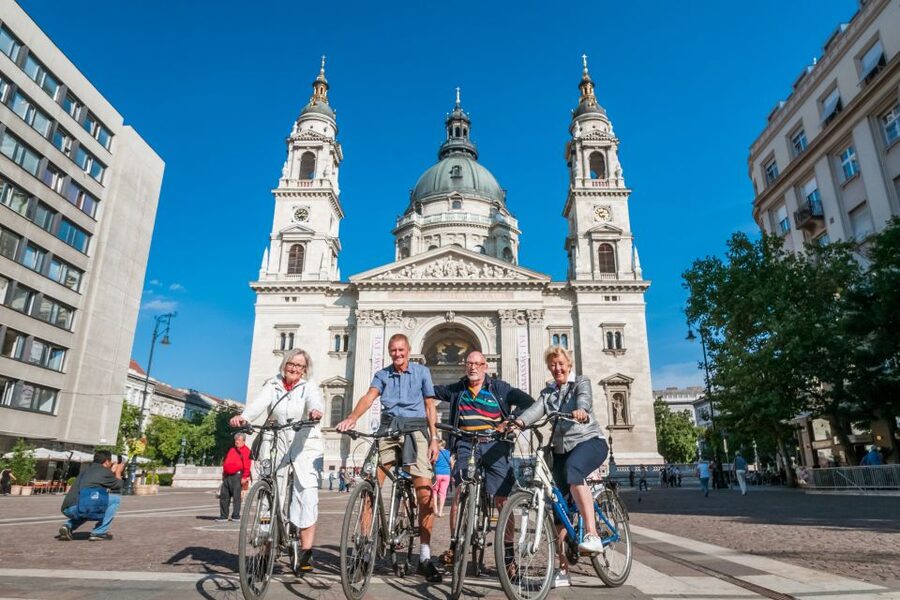
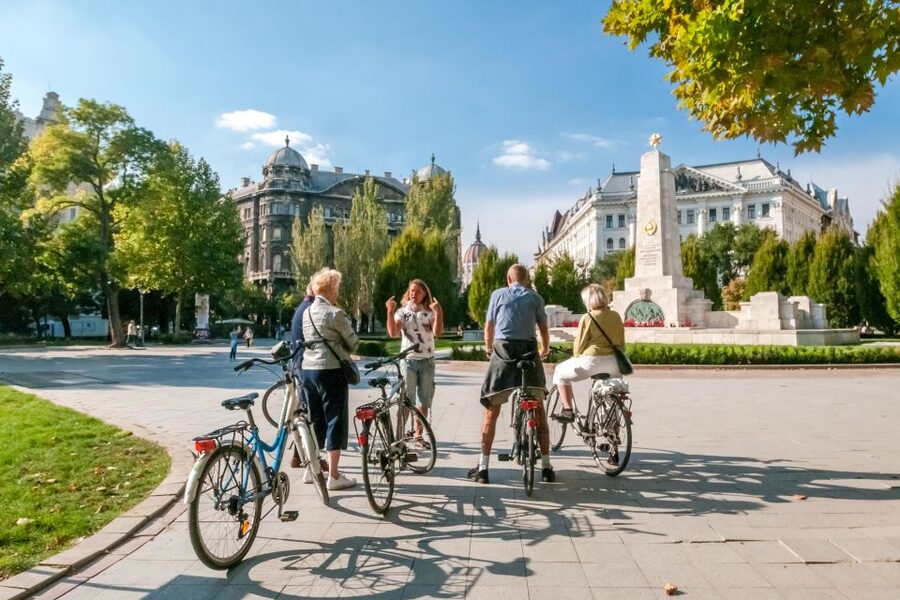
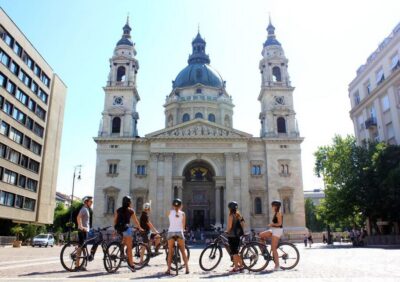
The ride begins at Szent István tér, near St. Stephen’s Basilica, unless your booking gives a different meeting point. From there, the group heads to Szabadság tér, or Liberty Square.
This is a useful first stop because Budapest’s political past is visible in one compact place. The Soviet Army monument recalls the period after the Second World War, while the square itself has witnessed revolutions, protests, and public unrest. The guide uses the setting to explain the forces that shaped Hungary, rather than reducing the city to pretty buildings and royal stories.
You should expect about ten minutes here. That is enough for an introduction and a few photographs, but not a long lecture. The guide-led format works well because you can ask about the parts of Hungarian politics and history that interest you most.
The Danube, Shoes on the Bank, and Parliament
The next stretch brings you toward the river and the Shoes on the Danube Bank memorial. The stop is brief, around five minutes, but the subject deserves your attention. The iron shoes recall Jewish people murdered on the riverbank during the Second World War.
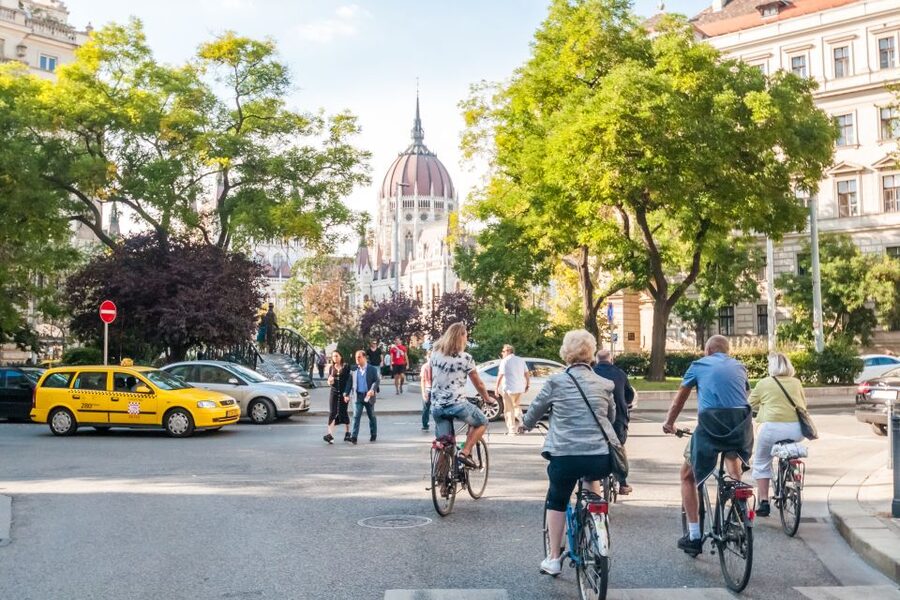
After the memorial, you reach the Hungarian Parliament Building. Its neo-Gothic exterior is one of Budapest’s clearest visual symbols, with towers, arches, and a long riverfront facade. The guide points out the building’s scale and details, including its 28 staircases, said to total more than 20 kilometers in length.
The listed sightseeing stop is short, so this is not a substitute for an interior Parliament visit. Think of it as a strong exterior introduction and a chance to see the Danube from the Pest side. You get a fine first view across the water, though the tour does not promise time to cross into Buda or explore the castle district.
I value this part of the ride because the memorial and Parliament sit close together but represent very different chapters of the country’s story. One stop asks you to pause quietly. The next shows the ceremonial face of the modern state.
Andrassy Avenue and the city’s Broadway
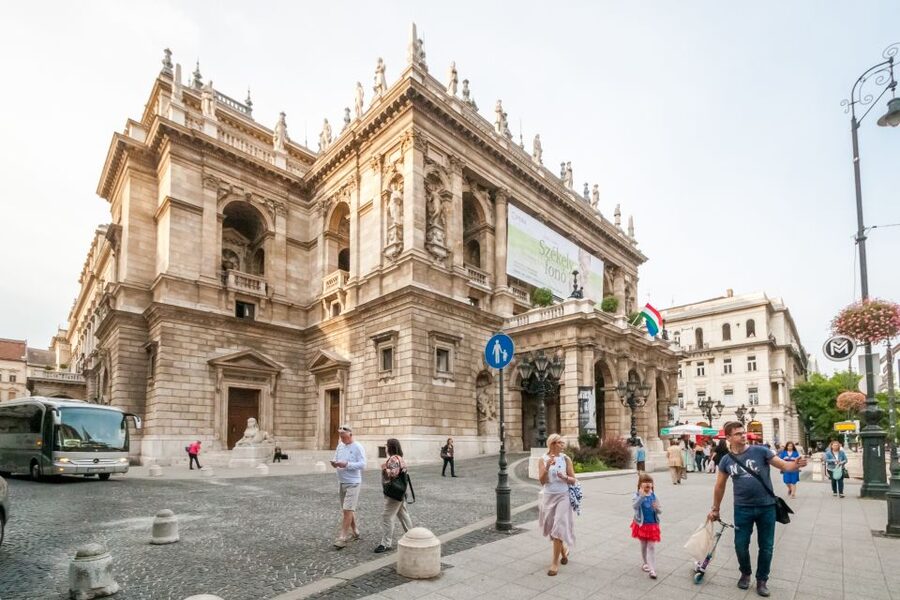
From the river, the route moves toward Andrassy Avenue, Budapest’s grand boulevard. The avenue is lined with ornate buildings, cultural institutions, and high-end shops. It gives you a feel for the city’s 19th-century ambition and its present-day style without requiring a separate shopping walk.
You also pass Nagymező Street, often called Budapest’s Broadway. The area has theaters, bars, and clubs, and the guide may offer suggestions for an evening out. This is one of the more useful touches of the tour. You are not only learning what a building is, you are finding out how the city works after dark.
Cycling is especially helpful here because the route links several different moods. One minute you are looking at formal architecture, and soon you are moving through entertainment streets and local neighborhoods. You can cover the distance without losing the sense of place that disappears inside a sightseeing bus.
Do not expect long stops at every theater or shop. The point is to understand the avenue and note places you may want to revisit. If your priority is fashion, architecture, or nightlife, tell the guide early.
More bike tours around Budapest:
- Budapest: Grand Sightseeing Bike Tour
★ 4.8 · 984 reviews - Budapest Highlights Bike Tour
★ 5.0 · 770 reviews - Budapest: Guided Bike & E-bike Tour with a Goulash
★ 4.8 · 220 reviews - Budapest: Guided City Tour by E-Bike
★ 4.9 · 87 reviews
Heroes Square and City Park
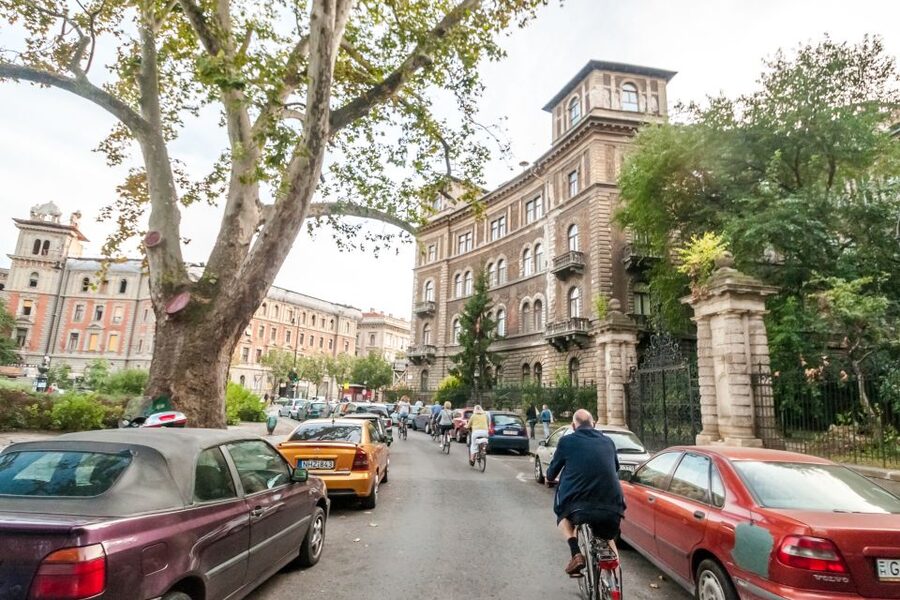
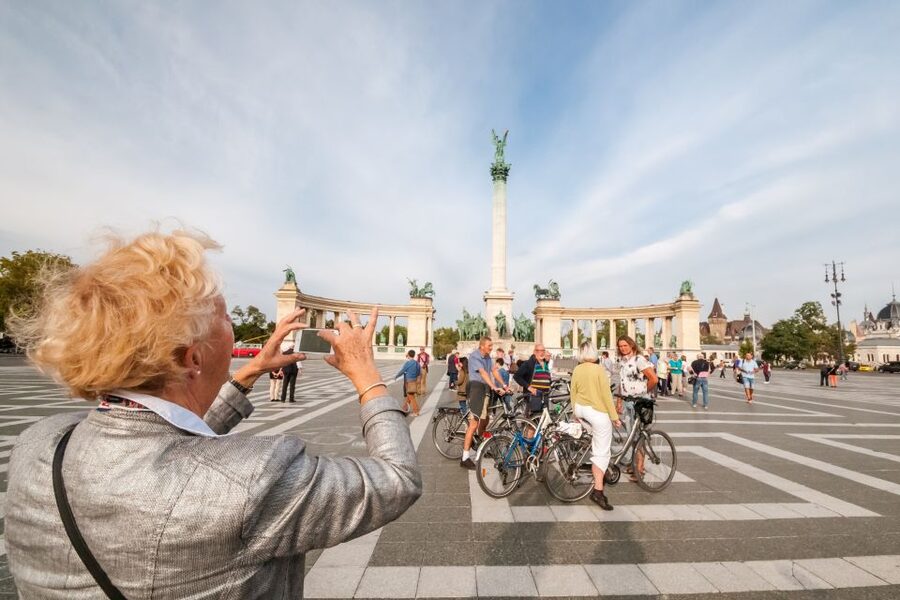
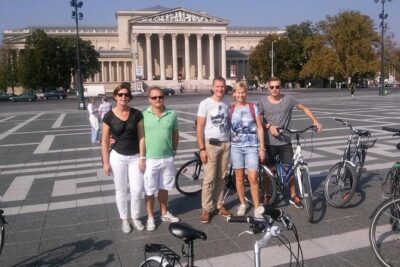
Heroes Square is one of the tour’s main visual moments. Its statues honor important figures from Hungarian history, and the wide open space makes a sharp contrast with the narrow streets closer to the center.
The stop lasts about ten minutes. That gives you time to look across the monument, hear the basic story, and take pictures. A guide is useful here because the figures and symbols can feel hard to read on your own.
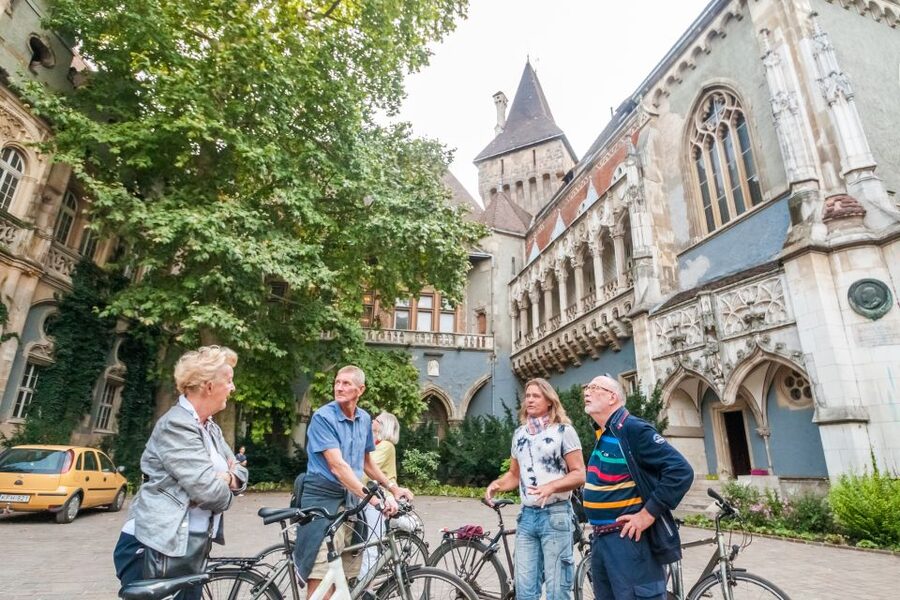
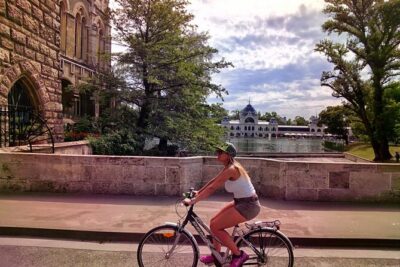
After Heroes Square, you move into Városliget, or City Park. This is one of Budapest’s best changes of pace, with gardens, open green areas, and room to pause. The route includes Vajdahunyad Castle, where you can relax and look around the grounds.
The castle is especially appealing because its architecture brings together several Hungarian styles in one playful complex. The tour does not promise an interior visit, so treat the stop as a chance to see the outside and enjoy the park.
This portion also helps you judge how much time to allow for a later visit. City Park contains enough attractions for a longer outing, but the bike tour gives you only a compact introduction.
Szechenyi Bath, the Zoo, and a practical city overview
The route passes the Szechenyi Thermal Bath, one of Budapest’s best-known bathing complexes. You stop for about five minutes, mainly to see where it is and understand its position within City Park.
That short stop is useful if you are considering a bath visit later. It is not enough time to change, enter, or use the pools, so bring a separate plan if thermal bathing is high on your list.
You also pass Budapest Zoo and Botanical Garden and the former Fun Park area. These stops broaden the tour beyond monuments. You see how City Park serves as a recreation district for both residents and visitors.
I like this part because it gives you practical choices for the rest of your stay. You can return to the park for a bath, gardens, or family attractions, instead of treating it as a single photo stop and moving on.
Winding streets, the Opera House, and the Jewish Quarter
The return ride heads back through smaller, winding streets toward the Basilica. This is where the tour’s pace can feel most rewarding. You move away from the headline sights and see older buildings, some damaged during the civil war, along with less obvious corners of central Budapest.
The Hungarian State Opera House is another photo stop. Its ornate frontage fits the grand style of Andrassy Avenue, and the guide can place it within Budapest’s performing-arts scene. Again, expect an exterior view rather than a performance or inside tour.
The route then reaches the Jewish Quarter and the Big Synagogue, also called Nagy Zsinagóga. It is the largest synagogue in Europe, and the surrounding district carries layers of religious, social, architectural, and wartime history. The listed sightseeing stop is around ten minutes, enough for an introduction but not a full exploration of the neighborhood.
This is a good reason to take notes. The Jewish Quarter rewards a return visit, especially if you want more time with its synagogues, memorials, food, and evening venues. The bike tour gives you the location and broad context, then leaves you free to come back on foot.
Chain Bridge and the route back
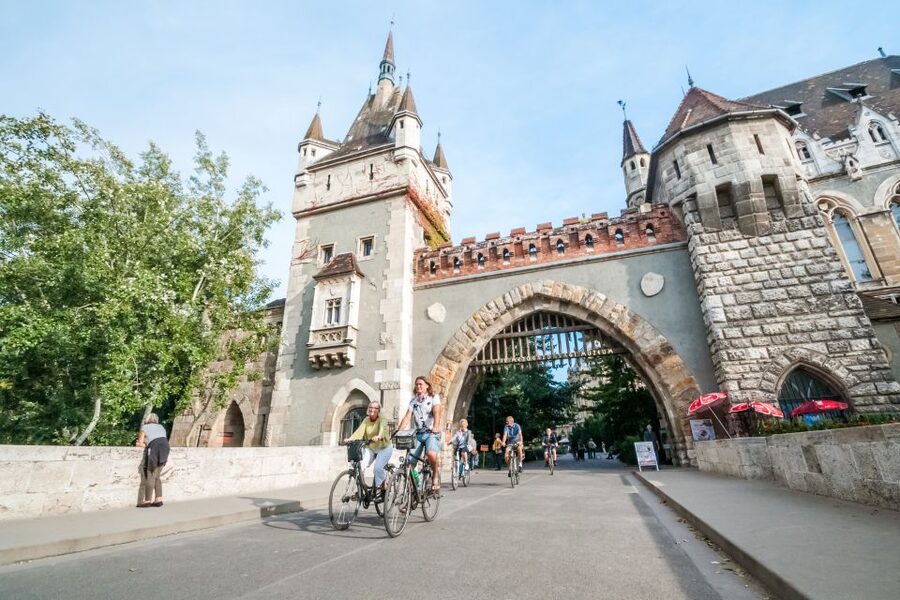
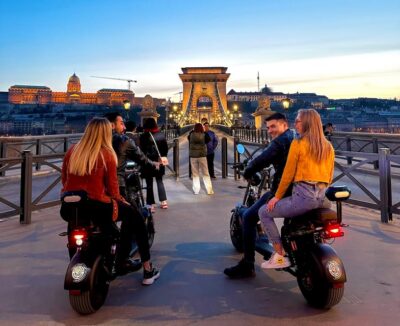
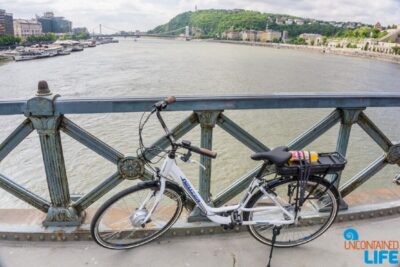
The tour includes a photo stop at Chain Bridge. The bridge links Pest and Buda and gives you a familiar Budapest view across the Danube. You may see the Buda hills from the Pest side, though this route does not turn into a full Buda sightseeing tour.
The final stops lead back toward Szent István tér and the Basilica area. Depending on the selected option, the drop-off is listed at Szent István tér or the activity provider’s location. The route ends where it began in the central city, which is convenient for continuing to lunch, a museum, or an evening walk.
Because the tour covers so much ground, the return ride helps connect the sights in your mind. Parliament is no longer an isolated stop, and the Opera House, Jewish Quarter, and Basilica area begin to feel like parts of one walkable city.
Guides, group size, and the human side of the ride
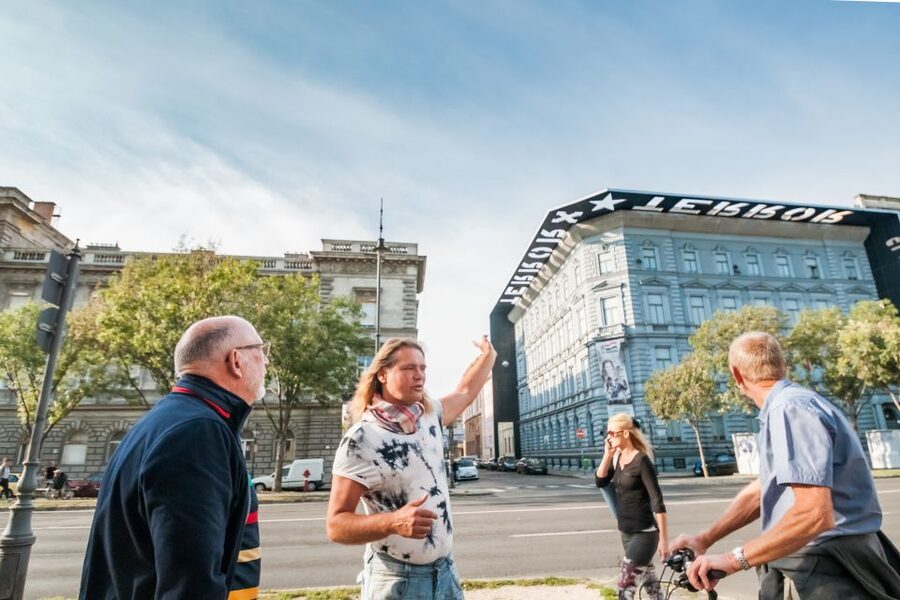
The guide is the biggest variable, and the experience depends heavily on that person’s style. Sam is praised for humor, local knowledge, and real enthusiasm for Budapest. Laszlo is described as friendly, clear, and strong on Hungarian history. Veronica has a reputation for tailoring the route to specific requests and for leading safely through city traffic.
Other guides named in past departures include Ward, Marcel, Mátyás, Peter, Kristóf, Lily, Christoph, and Lasic. The available languages are English, Dutch, and German.
Several departures have been small, including groups of three and five. A small group makes it easier to ask questions, keep a comfortable pace, and request a brief adjustment if you have a particular interest. Group size can vary, so do not assume every departure will feel private.
The best approach is to tell the guide at the start if you care most about political history, architecture, Jewish Budapest, nightlife, or local food. The tour has enough flexibility for a personal conversation, and past guides have made room for requested sights when possible.
What is included, and what to bring
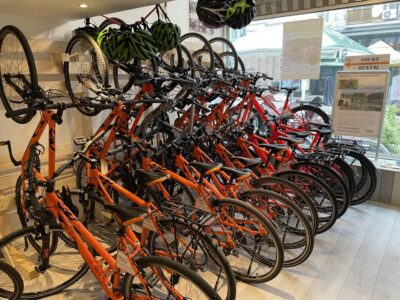
The $38 price includes the personal guide, bicycle, and helmet according to the activity details. That is fair value for 2.5 hours of guiding and equipment, especially when you consider how many districts you reach.
The tour does not include entry to Parliament, Szechenyi Bath, the Opera House, the Zoo, or the synagogue. Those are viewed from outside or visited briefly, so budget separately if you want to go inside.
Wear comfortable clothes and shoes that work on a bicycle. The activity does not allow baby strollers, baby carriages, luggage, or large bags. Children under eight cannot join.
Cancellation is free up to 24 hours before the start for a full refund, and you can reserve now and pay later. Starting times depend on availability, so check the specific departure before you build the rest of your day around it.
Who should book this Budapest bike tour?
I would book this for a first or second day in Budapest. It gives you a working map of Pest, points out places worth returning to, and lets you ask a local guide what to do with the rest of your visit.
It suits adults, older children who meet the minimum age, casual cyclists, and anyone who finds walking tours too slow. You do not need an athletic level of fitness, and the flat route makes an e-bike unnecessary for many riders.
It is less suitable if you want long interior visits, a full Buda experience, or a strenuous cycling adventure. You also need to be comfortable riding near urban traffic and managing a bike for several hours.
Should you book it?
Yes, if you want a friendly, efficient introduction to Budapest and prefer movement over standing in one square at a time. The combination of Parliament, the river memorials, Andrassy Avenue, Heroes Square, City Park, the Opera House, the Jewish Quarter, and Chain Bridge is hard to match on foot in the same time.
Book it early in your stay, tell the guide what interests you, and plan to revisit the stops that deserve more time. At $38, it is a solid choice for covering ground, getting local advice, and seeing how Budapest’s grand sights fit together.
FAQ
How long is the Budapest bike tour?
The tour lasts 2.5 hours.
How much does the tour cost?
The listed price is $38 per person.
What sights does the route include?
The route includes Liberty Square, Shoes on the Danube Bank, the Hungarian Parliament Building, Heroes Square, Szechenyi Thermal Bath, Budapest Zoo and Botanical Garden, City Park, the Hungarian State Opera House, the Jewish Quarter, Chain Bridge, and other central sights.
Is the route difficult?
The route is mostly flat, especially on the Pest side. Several riders found it easy and suitable for ordinary fitness, but you still need to be comfortable cycling in city traffic.
Is a bicycle included?
Yes. A bicycle, helmet, and personal guide are included in the activity details.
Which languages are available?
The tour is offered in English, Dutch, and German.
Can children join the tour?
Children under eight are not permitted to join.
Can I bring luggage or a stroller?
No. Baby strollers, baby carriages, luggage, and large bags are not allowed.
Can I cancel for a refund?
Yes. You can cancel up to 24 hours in advance for a full refund. You can also reserve now and pay later.
New rides added around Budapest
- Budapest ❤️Winter Bike Tour with Coffee Stop❤️★ 4.8 · 20 reviews
- Budapest: Self-Guided Bike Tour to scenic Szentendre★ 4.6 · 24 reviews
- Budapest to Szentendre e-Bike Tour with a local guide★ 5.0 · 10 reviews
- Budapest: Guided Bike Tour Plus★ 4.7 · 62 reviews
- Budapest Highlights Bike Tour with a local guide★ 4.9 · 66 reviews
- Budapest: E-Bike Guided Tour and Castle Hill★ 4.9 · 241 reviews
- Budapest: Guided City Tour by E-Bike★ 4.9 · 87 reviews
- Budapest: Guided Bike & E-bike Tour with a Goulash★ 4.8 · 220 reviews
Budapest Bike Tours, compared.

Budapest Highlights Bike Tour with a local guide
Read our review →Browse the lists this tour appears in