
Review · ROME
Appian Way Aqueducts Bike Tour (Catacombs & Lunch Option)
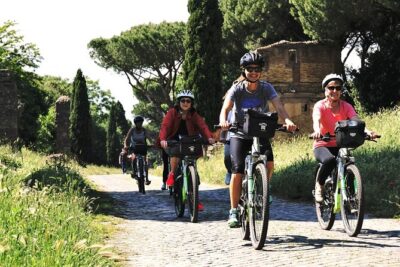
Rome’s best bike ride may be the one that gets you away from Rome’s traffic. This small-group trip rolls through the Appian Way and Caffarella Park, where old stones, sheep, trees, tombs, and aqueducts replace the usual city crush. The e-bike helps, but this is still a real ride.
I like two things here: the variety of the route, from Roman walls and cobbles to dirt tracks and open parks, and the guides, including Ava, Alex, Chris, Iman, and Paolo, who are praised for clear riding advice and lively Roman stories. The main catch is simple: rough stones, city traffic, and several hours in the saddle demand solid bike skills.
Key points to know before you book
- The five-hour option adds the St. Callixtus Catacombs, lunch, and an aperitif.
- The Appian Way includes large, uneven cobbles, dirt paths, short hills, and some city riding.
- Electric assistance makes the distance manageable, but it does not turn the outing into a passive sightseeing ride.
- The route reaches aqueducts, Roman tombs, baths, parks, and the Circus of Maxentius in one outing.
- Groups are limited to 12 people, keeping the guide’s safety instructions and explanations within reach.
- Children ages 6 to 10 must be under 143 centimeters tall and ride with a trailer bike rather than alone.
Why this ride shows you a different Rome
At $78.60 per person, this is not the cheapest way to spend half a day in Rome. It is a useful value if you want several historic sites, a guided route, an e-bike, and a break from the city center in one booking.
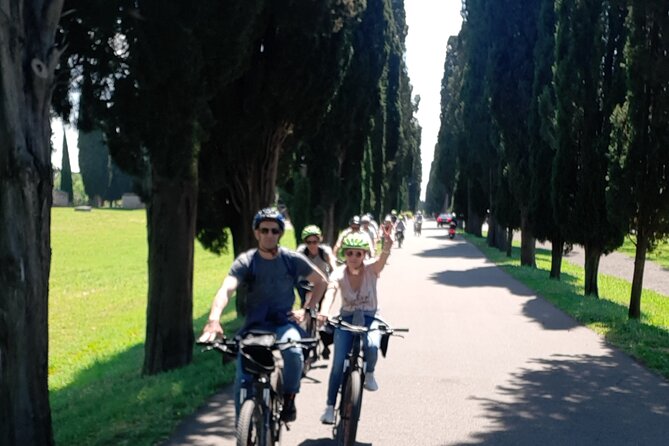
The real appeal is the change of pace. You begin near the Colosseum, ride through Rome’s southern streets, pass the Aurelian Walls, and soon reach broad green spaces. The ancient Appian Way is not a polished pedestrian avenue. It is an old road with large stones and deep gaps, surrounded by ruins and open countryside. That roughness is part of the experience, though it also explains why the operator asks for moderate fitness and strong bike skills.
You get a high-quality e-bike, helmet, phone holder, handlebar holder, and child seat equipment. The bikes help on inclines and make a longer route possible in warm weather. Several people found the seats uncomfortable, though, and one rider described the bikes as clunky but effective. Bring water, wear practical clothes, and expect a sore backside before the day is over.
More Bike Tours with Lunch in Italy
- Rome: Appian Way E-Bike Tour Catacombs, Aqueducts & Picnic
★ 4.6 · 727 reviews - Rome: Appian Way Aqueducts Bike Tour (UPG Catacombs & Lunch)
★ 4.9 · 692 reviews - Florence: Chianti E-Bike Tour with Lunch & Two Wine Tastings
★ 4.7 · 231 reviews
Meeting near the Colosseum and getting moving
The tour starts at Roma STARBIKE, at Via dei SS. Quattro 58, a short distance from the Colosseum. You meet your guide and group at the shop, receive a helmet, and get fitted to the e-bike before setting off.
The first city section is the part that may make you nervous. You are riding through Rome, not starting on a quiet country path. Guides such as Alex, Ava, Chris, and Iman are praised for keeping an eye on the group, giving clear instructions, and checking that riders are comfortable. That support matters most in the opening stretch, when you are still learning the brakes, balance, and electric assistance.
Pay attention during the safety briefing. One rider who was new to e-bikes had a fall after misjudging the strong brakes, though the guide helped and the rider continued. This is not a reason to avoid the tour, but it is a reason to practice gently and leave plenty of space.
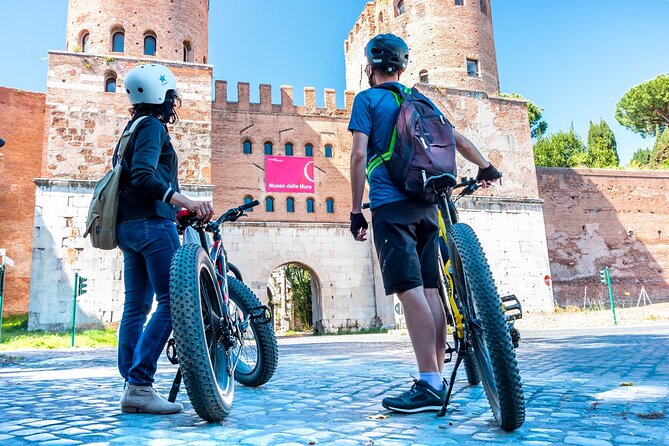
Porta San Sebastiano and the Aurelian Walls
The first formal stop is Porta San Sebastiano, a powerful gate in the Aurelian Walls. Built around 275 AD, it marks the start of the historic Via Appia Antica.
This is a good first pause because it connects the modern ride with Rome’s defensive past. The gate also carries medieval graffiti, evidence of pilgrims who passed through over many centuries. You have about 15 minutes here, enough for photos and a short explanation before the route leaves the city’s dense center.
Do not expect a long museum visit at this stop. Its value is in the setting and in the transition. You are crossing from present-day Rome into a section where the old road system, walls, tombs, and aqueducts still shape what you see.
Caffarella Park: open space inside the ancient city
Parco della Caffarella is one of the pleasures of this trip. The park is a broad green area within the Appian Way Archaeological Park, with paths, groves, farmland, and remains of ancient buildings.
You ride for about 50 minutes through this quieter part of Rome. The route can include dirt and uneven ground, so you need to steer actively rather than simply follow a smooth cycle path. The e-bike and suspension help, but you still need to watch the surface.
This is where the tour feels least like a standard city excursion. You might see goats, chickens, turtles, and other signs of rural life alongside Roman remains. The contrast is the point: Rome’s ancient edge still has space, trees, and working countryside rather than only monuments behind barriers.
More Bike Tours with Lunch in Rome:
- Versailles Full Day Bike Tour with Palace, Gardens, & Picnic
★ 5.0 · 2,217 reviews - From Paris: Versailles Bike Tour w/ Palace, Gardens, & Picnic
★ 5.0 · 2,150 reviews - Electric Cycling Tour of Ubud with Free Hotel Transfer and Lunch
★ 5.0 · 1,397 reviews - Bangkok: Bike and Canal Boat Tour with Lunch
★ 4.9 · 1,350 reviews
The Appian Way and its enormous paving stones
The Via Appia Antica was begun in the fourth century BC under the censor Appius Claudius and later extended toward Brindisi. It carried troops, trade, and people south from Rome, earning the name Regina Viarum, or queen of roads.
Riding here gives you a physical sense of Roman engineering. You do not just look at a road in a museum display. You feel its uneven stones beneath the tires, see how the route cuts through the countryside, and pass tombs and villas along the way.
The riding is also the tour’s biggest challenge. Some stones are larger than dinner plates, with deep spaces between them. At times you can use dirt beside the road, but not always. You may need to slow quickly, steer around other cyclists, and handle short downhill sections on narrow tracks.
I would not book this if you have not ridden a bicycle in years. An e-bike removes much of the effort on hills, but not the need for balance, braking, and control. If you ride regularly, the rough surface becomes part of the fun. If you want a smooth, easy roll, choose another way to see the Appian Way.
The optional catacombs at St. Callixtus
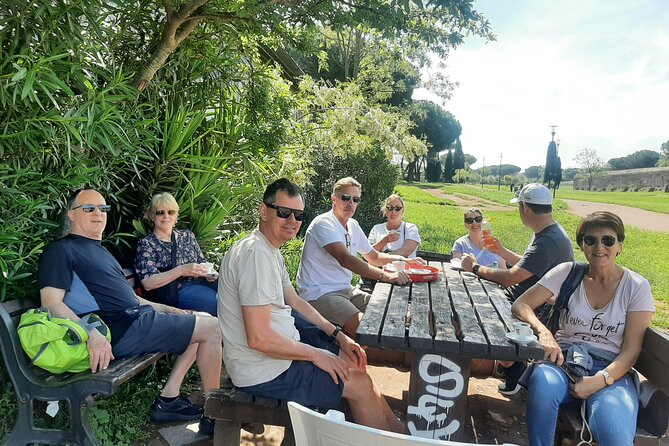
The St. Callixtus Catacombs are included only on the five-hour tour. The visit lasts about 50 minutes and takes you below ground into one of Rome’s largest underground cemeteries.
The complex has corridors extending for about 20 kilometers, and its burials include more than 50 martyrs, 16 popes, and many thousands of Christians. The catacombs date to the early centuries of the Church of Rome and add a very different mood to the outdoor ride.
This is a guided visit, not a self-directed wander. Expect a darker, more enclosed historical stop after the open parkland and road. If underground sites interest you, the catacombs make the longer tour much more rewarding. If you are short on energy or uneasy in confined spaces, the four-hour ride may suit you better.
The timing also matters. The five-hour version is not simply an extra hour of easy cycling. It adds a major visit, food, and more riding, so you should choose it because you want a fuller day, not just because it appears to offer more for the money.
Egeria’s spring and the tomb of Cecilia Metella
The route pauses at the Ninfeo di Egeria for about 20 minutes. The site is linked to Egeria, the nymph associated with Numa Pompilius, Rome’s second king. According to the old story, her grief after his death created the spring.
Whether you treat the tale as myth or folklore, it gives the stop a human touch. Not every pause is another giant monument. Some are small places where Roman stories, water, and the surrounding countryside meet.
Next comes the Mausoleum of Cecilia Metella, a well-preserved pagan tomb from the first century BC. It was later incorporated into the medieval Castrum Caetani, where you can see remains of the Caetani family’s residence and the walls of the church of San Nicola.
This is one of the strongest stops for understanding how Rome keeps changing while leaving older layers visible. A pagan tomb became part of a medieval fortress complex, and the medieval church now survives mainly as a perimeter. You get about 20 minutes, so listen closely and use the time for photos.
Aqueduct Park and the five-hour food stop
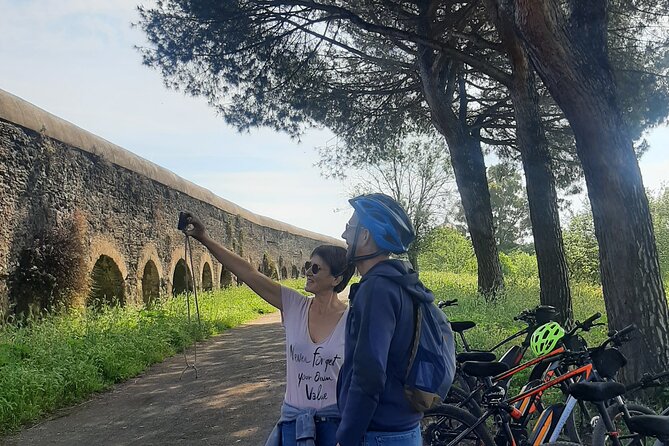
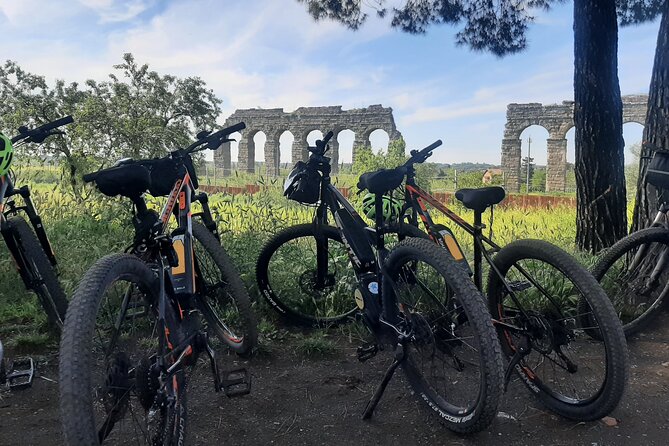
The five-hour tour continues to Parco degli Acquedotti. Here, the remains of the Claudio aqueduct dominate the open park, with arches crossing the grass and broad skies above.
This is one of the most photogenic parts of the route, but it is also more than a pretty backdrop. The park shows how Roman water infrastructure worked across a huge area. Several aqueduct remains can be seen, and some water channels are still in use.
The food arrangement deserves a close look. The morning five-hour version includes lunch, while the afternoon version includes an aperitif instead of brunch. The published description calls it a boxed lunch in one place and a simple restaurant meal in another, so confirm the exact food schedule when booking. Either way, do not expect the shorter four-hour tour to include food.
The stop lasts about 40 minutes for the meal, followed by roughly 20 minutes of riding through the aqueduct park. That pause can make the longer route easier, especially in warm weather, but you still need to budget five hours for the complete outing.
Circus of Maxentius and the return to Rome
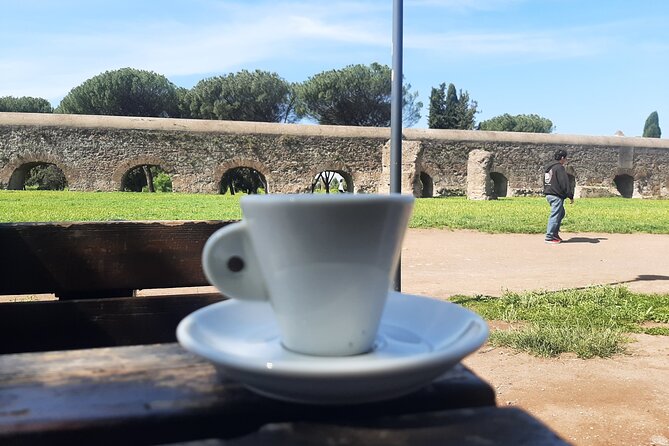
The Circus of Maxentius sits along the Appian Way and is one of the best-preserved Roman circuses. Its long shape and central spina remain visible, helping you picture the chariot-racing venue that once occupied this space.
The obelisk that once stood on the spina was moved during the Renaissance and now appears in Piazza Navona’s Fountain of the Four Rivers. That small detail links this quieter archaeological site with one of central Rome’s famous squares.
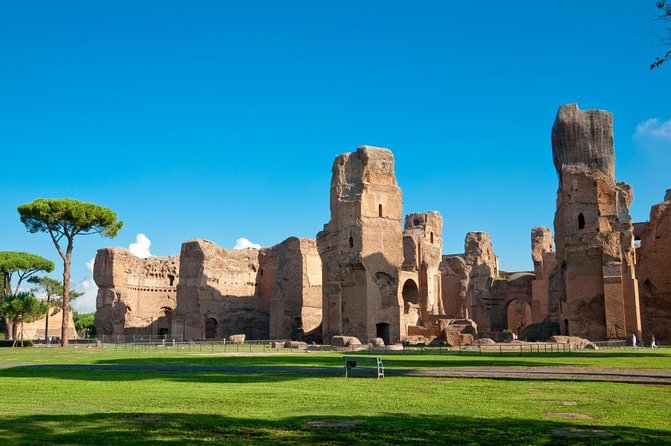
After the circus, the group rides back toward the city and stops at the Baths of Caracalla. Built by Emperor Caracalla, these baths were once the largest public bathing complex in the Roman world for about a century. Much of the structure remains, and the scale is easy to appreciate even during a 15-minute stop.
The return route brings you back through the ancient walls and past the area of the Porta San Sebastiano before ending at the bike shop. You return the e-bike and helmet at the original meeting point.
Guides, group size, and the value of the commentary
The tour is limited to 12 people, a useful size for city riding and rough paths. A guide can see more of the group, stop for questions, and give individual help when someone needs a slower pace or a reminder about braking.
Guide names praised in the supplied material include Ava, Alex, Chris, Iman, Paolo, Lorenzo, and Ricardo. Their shared strengths are practical rather than flashy: safe group handling, patience, clear instructions, and stories that explain why a ruin matters.
I especially value that combination on this route. You are not simply pedaling past aqueducts. You are learning how roads moved Roman armies, how water reached the city, how tombs lined the Appian Way, and how later families reused ancient buildings.
The guide cannot remove every difficulty. The route still includes traffic, cobbles, dirt, hills, and other cyclists. What a good guide can do is make those sections feel manageable, and the strongest guides appear to do exactly that.
Who should choose four hours and who should choose five
Choose the four-hour tour if you want the main outdoor route without the catacombs and meal. It is still a full outing with city streets, Caffarella Park, the Appian Way, Cecilia Metella’s mausoleum, aqueducts, the Circus of Maxentius, and the Baths of Caracalla.
Choose five hours if you want the St. Callixtus Catacombs and appreciate a planned food break. The longer option gives you more context and more time outside the center, but it also asks more of your legs and attention.
This experience suits:
- Confident cyclists who want a break from Rome’s central streets
- Families with children who meet the height and age rules
- Visitors interested in Roman roads, water systems, tombs, and early Christian sites
- People who like active sightseeing and do not mind rough surfaces
- Anyone who wants a small-group outing with an English-speaking guide
It is less suitable for anyone who is unsteady on a bike, dislikes cobblestones, or wants a relaxed ride with no traffic. The operator gives a maximum weight of 120 kilograms, and children ages 6 to 10 must be under 143 centimeters tall for the trailer-bike arrangement.
Price, timing, and what to bring
At $78.60, the price covers the e-bike, helmet, phone holder, child seat equipment, and guide. The five-hour version also includes the guided catacomb visit plus lunch in the morning or an aperitif in the afternoon.
That is fair value if you would otherwise pay separately for transport to the Appian Way, a catacomb visit, and an aqueduct excursion. The price is less attractive if you want only a short bike ride or if you will struggle with the terrain.
Wear closed shoes and clothes suited to cycling. Carry water, protect yourself from the sun, and arrive ready to ride rather than expecting a motorized sightseeing tour. The tour requires good weather, and poor conditions can lead to a new date or full refund. Free cancellation is available until 24 hours before the start time.
Should you book the Appian Way e-bike tour?
Book it if you can ride a bike well and want to see Rome’s ancient outskirts in an active, unusual way. The aqueducts, Appian stones, Caffarella greenery, catacombs, and Roman ruins create a much broader picture of the city than a day spent only among central monuments.
Choose the five-hour version for the fullest experience, especially if the catacombs matter to you. Choose four hours if you want the open-air sights but know that several hours on a bike will test your stamina.
The honest warning is the same as the best reason to go: this is rugged. You will work, bounce over stones, and share some roads with traffic. If that sounds like a good trade for fresh air, ancient roads, and a quieter side of Rome, book it.
FAQ
Where does the Appian Way e-bike tour start?
It starts at Roma STARBIKE, located at Via dei SS. Quattro 58, 00184 Rome, near the Colosseum.
Where does the tour end?
The tour ends back at the Roma STARBIKE meeting point.
How long does the tour last?
The experience lasts approximately four to five hours, depending on the option you select.
Is the catacomb visit included?
The guided visit to the St. Callixtus Catacombs is included only with the five-hour tour.
Is lunch included?
Lunch is included in the morning version of the five-hour tour. The afternoon five-hour version includes an aperitif instead. Food is not included in the four-hour version.
What equipment is provided?
The tour provides a high-quality e-bike, helmet, mobile phone holder, handlebar holder, and child seat equipment. Child seats are available for children up to 25 kilograms.
Do I need to be an experienced cyclist?
You must know how to ride a bike well. The route includes city traffic, cobblestones, dirt paths, uneven ground, and short hills, so basic confidence on a bicycle is important.
Can children join the tour?
Children ages 6 to 10 may receive the child reduction only if they are under 143 centimeters tall. They use a trailer bike rather than riding a bike alone.
What happens if the weather is poor?
The experience requires good weather. If the operator cancels because of poor conditions, you can choose another date or receive a full refund. You can also cancel for a full refund if you do so at least 24 hours before the start time.
New rides added around Rome
- Night Tour of Rome with Top E-bike & optional Italian Dinner★ 4.9 · 108 reviews
- Rome E-Bike Tour: Ultimate Street Food and Market Feast★ 4.9 · 50 reviews
- Rome: Appian Way, Catacombs & Aqueducts by eBike + Transfer★ 4.9 · 421 reviews
- Rome’s Best by E-bike: Guided City Tour (Small Group or Private)★ 5.0 · 207 reviews
- Rome: Appian Way, Aqueducts & Catacombs (Small Group or Private)★ 5.0 · 103 reviews
- Private Rome City Bike Tour with quality Cannondale EBike★ 5.0 · 176 reviews
- Rome E-Bike Small Group Tour of the Appian Way with Private Option★ 5.0 · 130 reviews
- Rome: City Highlights Electric Bike Tour★ 4.9 · 343 reviews
Rome Bike Tours, compared.

Rome EBike Tour: Appian Way, Catacombs & Roman Aqueducts
Read our review →
Top Highlights & Hidden Gems Tour by Cannondale E-Bike
Read our review →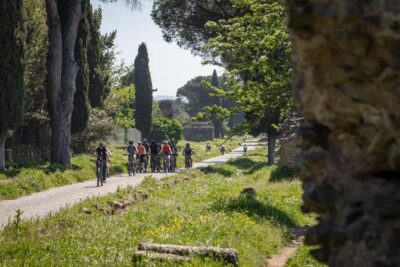
Appian Way & Aqueducts E-Bike Tour (Catacombs & Food)
Read our review →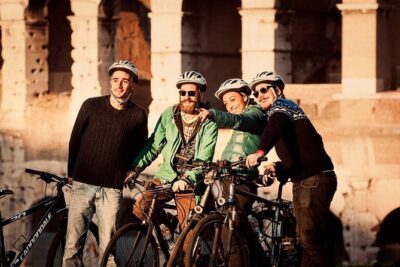
Rome City Small Group Bike Tour with quality Cannondale EBike
Read our review →
Rome by Night – Ebike Small Group Tour – Food and Wine (Option)
Read our review →
Appian Way, Catacombs and Aqueducts Park Tour with Top E-Bike
Read our review →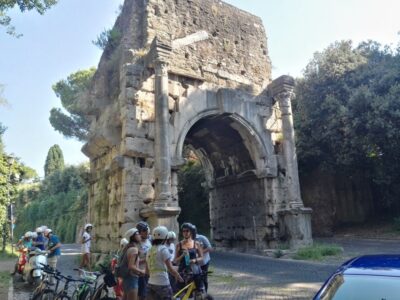
Appian Way Aqueducts Bike Tour (UPG Catacombs & Lunch)
Read our review →Browse the lists this tour appears in