Review · BIKE TOURS
Bucharest: Communist Bike Tour
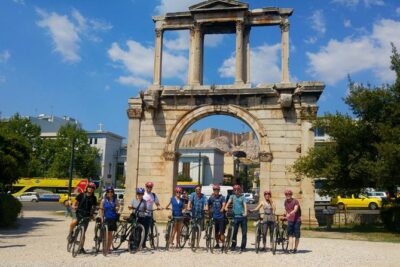
Bucharest’s communist past is easiest to grasp when you move through the city it reshaped. This four-hour bike tour links the old center, Coral Temple, the site of the first Romanian parliament, a Stalin-era neighborhood, Casa Radio, and Revolution Square into one clear story.
I like the wide reach of the route, since a bike lets you cover more ground than a walking tour. I also like the guides’ broader approach. Horia and Alex are praised for adding political, economic, religious, and everyday city context, not just pointing at buildings. The main drawback is city traffic, so this suits you best if you are comfortable cycling in a dense urban setting.
Key points to know before booking
- Four hours on two wheels: You cover several widely separated parts of central Bucharest without spending the tour waiting for transport.
- A strong political route: The stops connect the early communist movement, Soviet occupation, Stalin-era privilege, Ceaușescu’s final speech, and the 1989 Revolution.
- Coral Temple adds needed context: The tour looks at the Jewish community’s role among the early initiators of the communist movement in Romania.
- Casa Radio is a striking unfinished project: It shows how grand communist urban plans could remain incomplete and overpowering.
- English-speaking guides set the tone: Horia and Alex are singled out for clear, broad explanations and friendly help.
- Bring comfortable shoes: Bikes, helmets, and locks are provided, but food and drinks are not.
Why a bicycle works so well in Bucharest
Bucharest is spread out, and the key communist-era sites do not sit neatly around one square. A walking tour could explain the same history, but it would cover less ground and spend more time crossing the city. On a bicycle, you can connect the old center with the former political heart of Romania in a single morning or afternoon.
I like that the ride is not built around one grand palace or a single memorial. Instead, you see how ideology altered streets, neighborhoods, public buildings, and the city’s sense of place. The route moves from earlier political conflict to Soviet control, then to Ceaușescu’s final public appearance and the start of the 1989 Revolution.
The cycling itself is part of the lesson. You are not only looking at isolated monuments. You are moving through the spaces between them, where ordinary city life continues alongside the marks left by dictatorship. That makes the tour useful at the start of a Bucharest visit, when you are still learning how the city fits together.
Still, do not treat this as a relaxed park ride. One direct warning is worth taking seriously: Bucharest traffic can be dense, and the tour is not recommended for people with limited mobility. You should feel steady on a bicycle and comfortable paying attention to traffic while listening to your guide.
More bike tours around the world:
- Lion City Bike Tour of Singapore
★ 5.0 · 6,211 reviews - Big Bike tour Amsterdam – See all in 3 unforgettable hours
★ 4.7 · 4,929 reviews - 3-Hour Porto Highlights on a Electric Bike Guided Tour
★ 5.0 · 4,392 reviews
Starting in the old city center
The tour begins across from Hanu’ Berarilor, at Casa Oprea Soare, in Bucharest’s old city center. This is a practical starting place because the old center is one of the parts of the city most visibly shaped by layers of change.
Your guide begins by explaining how the communist period damaged this historic part of Bucharest. The point is not simply that old buildings disappeared. The broader lesson is how a government’s plans for roads, housing, and public space could cut through an older urban fabric.
I find this opening useful because it gives you a way to read the rest of the city. Look for the contrast between surviving historic structures and the large-scale planning associated with the communist era. The tour does not treat the old center as a decorative backdrop. It frames it as evidence of what political power can do to a city.
The meeting point is easy to identify by the nearby restaurant, but check the exact starting time when you reserve. The activity lasts four hours, and availability depends on the chosen start time.
Coral Temple and the early communist movement
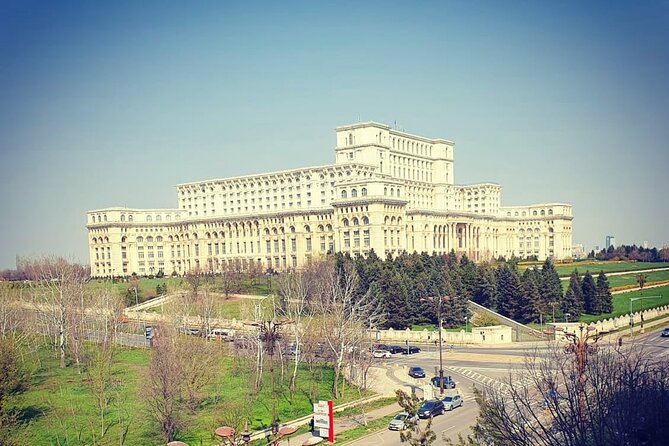
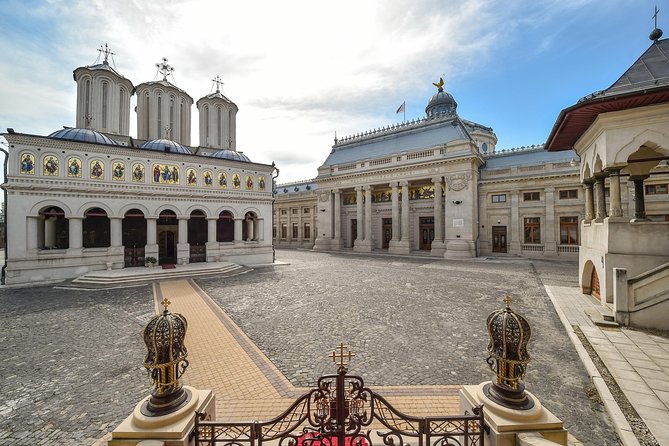
The next stop is Coral Temple, an important change of pace from the usual communist sights. The tour uses the site to discuss the Jewish community, which included some of the early initiators of the communist movement in Romania during the 1920s.
This part matters because it complicates a simple story of communism arriving only from outside the country. Romania’s communist movement had its own local political history, even though the Soviet Union later played a major role in the country’s direction.
Coral Temple also widens the tour beyond government buildings. You are looking at a religious and community site while discussing a political movement that promised to remake Romanian society. That contrast helps you understand why the period cannot be reduced to concrete blocks, party offices, and official speeches.
Your guide’s role is especially important here. The tour has been praised for covering religious life, the Orthodox Church, the city’s founding, and life in Bucharest today alongside the main political story. I would expect the Coral Temple stop to work best as a conversation about people and institutions, not as a long architectural visit.
The first Romanian parliament and the communist attack
The route then continues to the site of the communist bomb attack against the democratic Romanian government, identified as the first Romanian parliament. This is one of the tour’s most direct links between political action and physical place.
I like this stop because it shows that the communist story did not begin with Soviet occupation after the Second World War. The movement had already challenged Romania’s democratic government through violence. That early conflict sets up the later shift from political pressure to a Soviet-backed system of rule.
The stop is also a reminder that buildings can carry several meanings. A government site may look ordinary to you at first, yet its location can reveal a turning point in the country’s political life. A good guide makes that connection clear without burying you in dates and names.
The route does not promise entry into every site. This is primarily a cycling and interpretation experience, so you should expect to learn from outdoor stops and explanations rather than spend long periods inside museums or monuments.
Same wheels, a different route:
- Ninh Binh Full-Day Tour from Hanoi to Hoa Lu, Tam Coc & Mua Cave Via Boat & Bike
★ 5.0 · 4,384 reviews - Small Group Guided Bike Tour of Amsterdam’s Hidden Gems
★ 5.0 · 3,936 reviews - 3-hour Complete Prague Bike Tour
★ 5.0 · 3,674 reviews - Bangkok: Temples, Canals & Local Life Bike Tour
★ 4.9 · 3,511 reviews
Soviet occupation and the neighborhood for ruling elites
After covering the early communist movement, the tour moves into the period after the Second World War, when Romania was occupied by the Soviet Union for 12 years. The route passes through the neighborhood where Russian army generals who helped rule the country lived.
This is one of the more revealing parts of the ride. Political control is often discussed in terms of speeches and laws, but a neighborhood can show how power operated in daily life. The homes and setting associated with senior Soviet figures point to a ruling class with access and privilege during a period presented as a workers’ revolution.
The tour describes this area as a neighborhood built for communist elites during the Stalin era. That makes it a useful counterpoint to the official claims of equality. You may find the contrast sharper when you see the neighborhood as part of a broader urban route, rather than as a single isolated stop.
For me, this is where the bicycle has a real advantage. You can pass through the area and understand its position within Bucharest, instead of seeing one building without any sense of its surroundings. The ride gives the guide room to connect geography with politics.
Casa Radio and the cost of grand plans
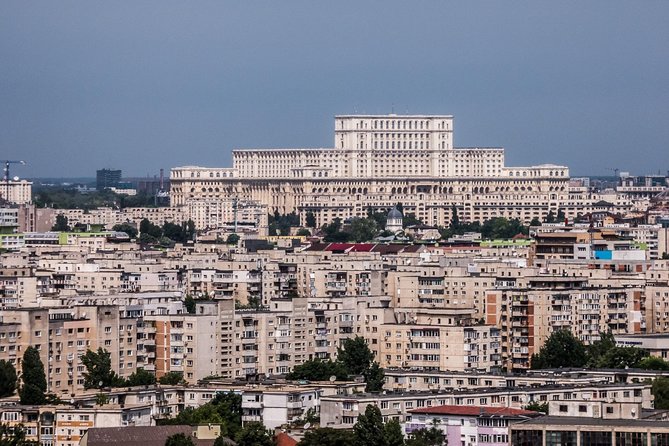
One of the tour’s most visually striking stops is Casa Radio, described as the largest unfinished communist urban project. The unfinished structure gives you a blunt look at the scale of communist planning and the gap between an official vision and the city that actually emerged.
An incomplete building can sometimes be harder to understand than a finished monument. There is no polished final message. Instead, you see an enormous project left in an unresolved state, which makes the costs and limits of centralized planning easier to discuss.
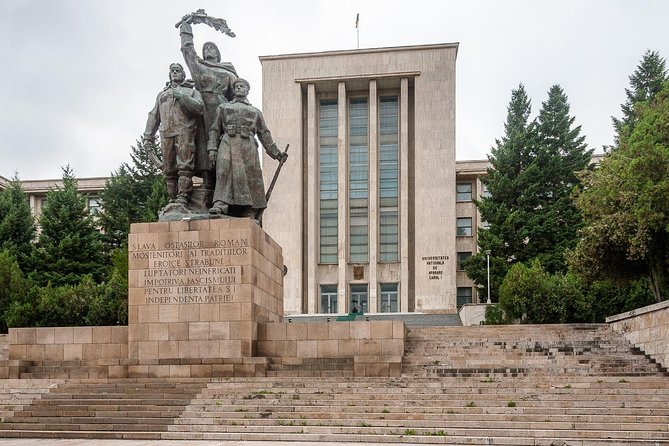
The route also refers to the National History Museum in connection with the final part of the tour, describing buildings that were completely reshaped by the communist regime during its most powerful period. Because the information about this section connects several major buildings, listen closely to your guide’s explanation of which structure you are viewing and how it was altered.
This stop should appeal to you if you prefer evidence over slogans. Casa Radio is not presented as a triumph. Its unfinished condition lets you think about ambition, resources, political priorities, and the lasting physical mark of the period.
Revolution Square and Ceaușescu’s last speech
The final stop is in front of the former Communist Central Committee, where Nicolae Ceaușescu gave his last speech and where the December 1989 Revolution began. This is the tour’s emotional and political endpoint.
The location ties together the story you have followed all day. You begin with the early communist movement and its attack on democratic government, pass through Soviet occupation and elite rule, then arrive at the moment when the communist system began to collapse in the streets.
I like ending here rather than at a museum because the square is tied to public action. Ceaușescu’s last speech took place in front of a crowd, and the Revolution began when public obedience broke down. The site turns political history into a question of how ordinary people respond when an authoritarian system starts to lose control.
Allow yourself a little time to take in the setting. The tour is four hours long, so the pace needs to keep moving, but Revolution Square deserves more than a quick photograph. If you are starting your Bucharest visit with this ride, you will have a strong reference point for later visits to the city’s museums and historic streets.
The guides and the quality of the explanation
The guide can make or break a history tour, and this experience seems to place real weight on interpretation. Horia is described as friendly and well informed, while Alex is praised for giving political, economic, and social context. Another tour account refers to Horia by the spelling Chorea, but the description clearly points to the same guide name.
The strongest part of the guiding style is its range. You are not limited to a list of communist buildings. The discussion can extend to Bucharest’s founding, the Orthodox Church, population groups, and city life today. That extra context helps you see communism as one period in a much longer story.
I would book this tour if you want an explanation of how the city works, not just a set of photo stops. The guides are also reported to offer practical help during the ride, which matters when you are spending four hours on a bicycle in an unfamiliar city.
The language is English. There is no indication of a choice of languages, so English should be comfortable for you before booking.
What the $53 price includes
The price is $53 per person. That is not the cheapest way to spend four hours in Bucharest, but the value depends on what you want from the visit.
Your ticket includes the live guide, bicycle, helmet, and bike lock. You are paying for the equipment as well as the guided route, and the bicycle lets you reach several parts of the city in one outing. If you would otherwise book separate walks or use taxis between distant sites, the price becomes easier to justify.
Food and beverages are not included. Plan to eat before or after the tour, and bring anything you need for the four-hour ride. Comfortable shoes are specifically recommended.
The booking terms also reduce some of the risk. You can cancel up to 24 hours in advance for a full refund, and you can reserve now and pay later. Those options help if your Bucharest schedule is still changing.
Who should book this ride
I would recommend it to first-time visitors who want a strong introduction to Bucharest’s communist period and a broader sense of the city. It is also a good fit if you enjoy political history, urban planning, and seeing how past governments changed ordinary streets and neighborhoods.
You should be comfortable riding a bicycle in dense city traffic. The tour is not suitable for people with mobility impairments, and the information provided does not suggest an adapted cycling option.
This is less suitable if you want a slow sightseeing ride with long stops, a museum-heavy experience, or a food tour. It is also not the best pick if you prefer to stay in one compact area. The attraction is the route itself, and the route covers ground.
Practical tips for a better four-hour ride
Wear comfortable shoes and clothing that lets you pedal easily. Bikes, helmets, and locks are supplied, so you do not need to arrange your own equipment.
Arrive at the meeting point across from Hanu’ Berarilor, Casa Oprea Soare, with enough time to get oriented. Since food and drinks are not included, take care of those needs before setting off or plan for after the tour.
Keep your attention divided between the road and the guide. The city traffic is part of the practical challenge, and you should not let a fascinating explanation distract you from safe riding.
If you have only one day in Bucharest, this can be a smart first activity. The route gives you a working map of the city and a political framework for later sightseeing.
Should you book the Communist Bike Tour?
Book it if you want to cover a lot of Bucharest while learning how communism shaped its government, neighborhoods, public buildings, and streets. The route has a clear progression, from the early movement and the first Romanian parliament to Soviet occupation, Casa Radio, and the Revolution Square finale.
I especially like the mix of stops. Coral Temple adds social and religious context, the Stalin-era neighborhood shows privilege, and Casa Radio reveals the unfinished side of grand political planning. With a strong English-speaking guide such as Horia or Alex, the tour can give you more useful background than a simple monument circuit.
Skip it if cycling in heavy city traffic makes you uneasy or if limited mobility makes a four-hour ride impractical. For confident cyclists, though, the $53 price is reasonable for the equipment, guide, and wide route, particularly at the start of a Bucharest stay.
FAQ
How long does the Bucharest Communist Bike Tour last?
The tour lasts four hours.
What language is the tour conducted in?
The live tour guide speaks English.
Where does the tour meet?
Meet across from the restaurant Hanu’ Berarilor, at Casa Oprea Soare, in Bucharest’s old city center.
Are bicycles included?
Yes. The ticket includes a bicycle, helmet, and bike lock.
Is food included in the price?
No. Food and beverages are not included, so plan to arrange them separately.
What should I bring?
Bring comfortable shoes suitable for a four-hour bicycle tour.
Can I cancel the booking for a refund?
Yes. You can cancel up to 24 hours in advance for a full refund.
Is the tour suitable for people with limited mobility?
No. The tour is not recommended for people with limited mobility and is not suitable for people with mobility impairments.
New rides added around the world
- Prague: E-Scooter HUGO Bike Rental★ 4.8 · 11 reviews
- Prague Electric Scooter and eBike Grand Tour★ 5.0 · 15 reviews
- Prague E-Bike City Ride tour : 2hrs★ 4.5 · 36 reviews
- Prague: E-Bike or E-Scooter Tour with A Local Guide★ 4.8 · 154 reviews
- Prague: City Viewpoints Tour by Electric Fat Bike★ 5.0 · 43 reviews
- Prague City Bike guided tour★ 3.7 · 10 reviews
- Prague: Classic City Bike Tour★ 4.7 · 149 reviews
- Prague: E-Bike/E-Scooter Viewpoint Tour★ 4.9 · 120 reviews
Bike Tours, compared.
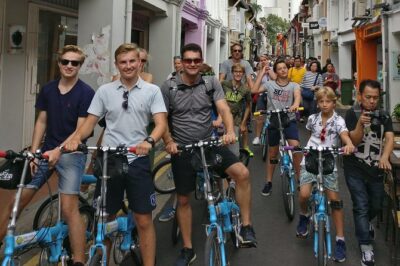
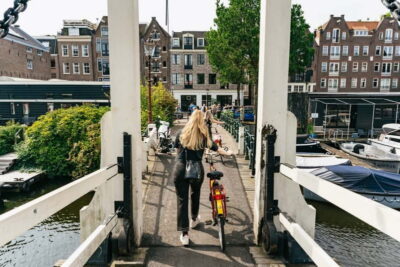
Big Bike tour Amsterdam – See all in 3 unforgettable hours
Read our review →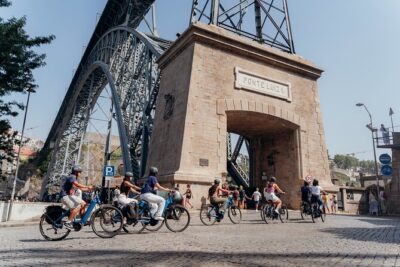
3-Hour Porto Highlights on a Electric Bike Guided Tour
Read our review →
Small Group Guided Bike Tour of Amsterdam’s Hidden Gems
Read our review →
Hills, Alfama, and Mouraria Tour by Electric Bike
Read our review →