
Review · MILAN
Milan: Guided Bike Tour
Milan reveals itself quickly from a bicycle. In 210 minutes, you move from the courtyards of Sforza Castle to Roman columns, canal-side Darsena, Piazza Affari, and the Duomo. It is a smart way to connect sights that feel scattered on foot, with enough stops to hear the story and take photos.
I like the small group of no more than 10 people, which makes it easier to ask questions and keep the pace comfortable. I also like the route’s mix of famous monuments and less obvious corners, especially the Roman ruins on Via Brisa and the canals.
The main drawback is that this is a city ride, not a slow walking tour. You will need comfortable shoes, suitable clothing, and enough confidence to cycle through central Milan. Large bags are not allowed, and the tour is not suitable for pregnant women or riders over 115 kilograms.
Key points to know before you ride
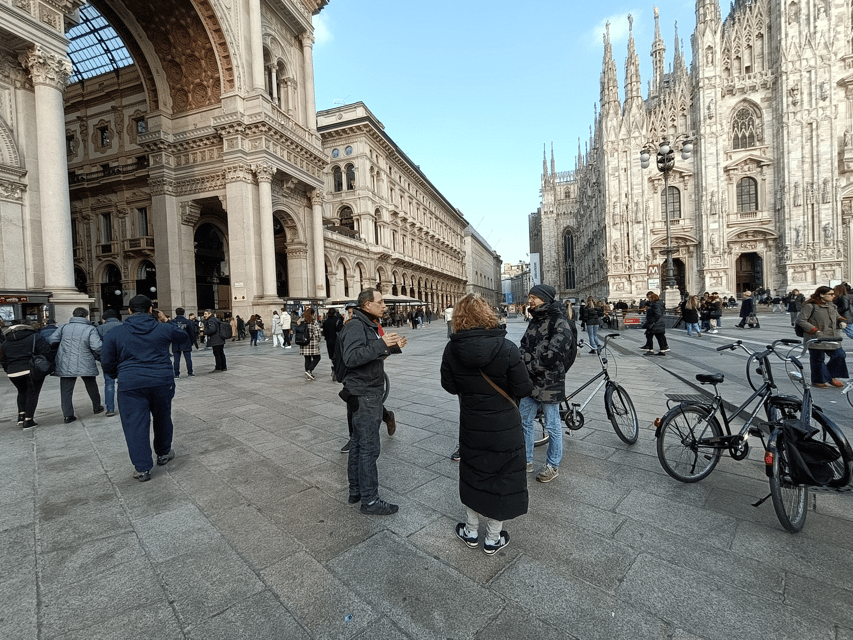
- Sforza Castle includes its inner courtyards: You do not simply pedal past the fortress, you stop for an explanation of its art and history.
- The route links old and modern Milan: Roman columns, a basilica, medieval squares, the Duomo, and Maurizio Cattelan’s L.O.V.E. sculpture all appear in one outing.
- The group is limited to 10 people: That makes the ride easier to manage and gives you a better chance to speak with the guide.
- Emilio and Katharine are notable guides: Emilio is praised for his storytelling and art knowledge, while Katharine is described as generous with time and attentive to the group’s pace.
- You get several photo stops: Darsena, the canals, Piazza Affari, and Duomo Square are built into the route rather than treated as quick drive-bys.
- The price is $57 per person: For three and a half hours with a bicycle, helmet, and live guide, this is fair value if you want a broad first look at central Milan.
Why a bicycle works so well in central Milan
Milan’s major sights are close enough to connect by bike, but spread far enough apart to make a walking day tiring. This route solves that problem. You get from Sforza Castle to the canals, then onward to Roman remains and the cathedral without spending much of your day crossing ordinary streets.
The bicycle also changes the feel of the city. You see the transitions between neighborhoods instead of moving from one isolated monument to another. The route uses bike paths and quieter streets where possible, although you should still expect normal city riding and pay attention around traffic.
The ride lasts three and a half hours, so it is long enough to give you a useful map of Milan without taking up a full day. I would choose it near the beginning of a Milan visit. Afterward, you can return to the places that caught your eye, such as the Duomo, Sforza Castle, or the Navigli area around the canals.
The maximum group size is 10. That is small enough for the guide to explain details without shouting, and it also helps at photo stops. The pace can still vary with the group, so this suits you best if you are happy to ride together rather than set your own schedule.
More guided departures in Italy:
- Milan: Hidden Gems Guided Bike Tour
★ 4.8 · 1,334 reviews - Florence: Guided E-Bike Tour to Piazzale Michelangelo
★ 4.4 · 1,204 reviews - Florence: 2-Hour Guided Sightseeing Bike Tour
★ 4.5 · 1,004 reviews
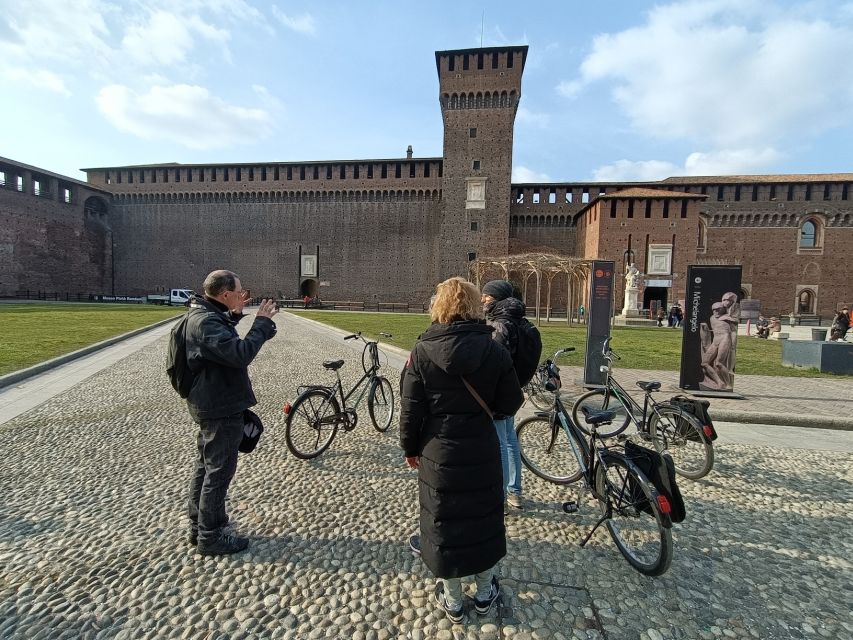
Starting at Sforza Castle and its courtyards
The tour begins at the Cargo bike store, where you meet the guide and collect your bicycle and helmet. Hotel pickup is not included, so you need to make your own way to the meeting point. Bring comfortable shoes, an ID card, and a copy of your payment or online voucher.
Sforza Castle is an excellent opening stop because it gives Milan a strong historical frame. From the outside, it looks like a fortified monument. Inside, the courtyards offer a closer look at how the complex functions as a major civic and cultural site.
Your guide explains the castle’s art and history while you visit the inner courtyards. This matters because a quick photograph of the walls tells you very little. The stop gives you context before the route moves into the rest of the city.
If you have already scheduled a full museum visit at the castle, keep your expectations clear. This cycling tour includes the outside and inner courtyards, not a full museum program. It is best viewed as an introduction that helps you decide if you want to return for more.
Peace Arch, Santa Maria delle Grazie, and the canal stop
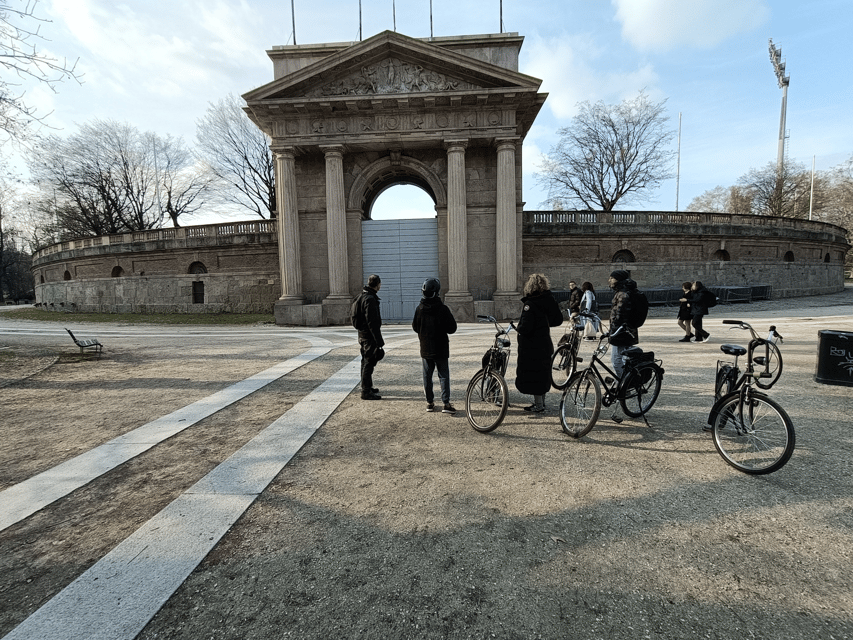
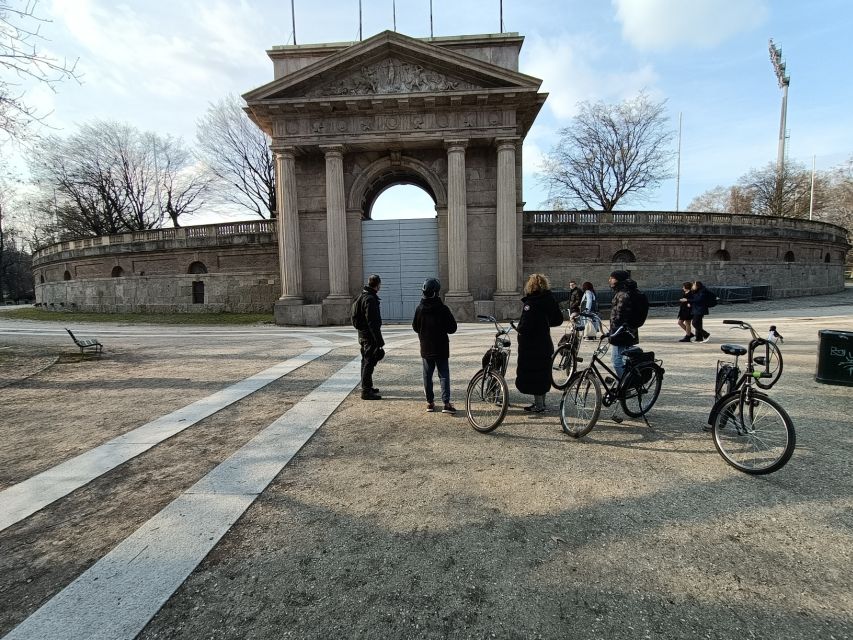
The route continues toward the Peace Arch and Santa Maria delle Grazie. The description of the tour places Santa Maria delle Grazie among the important sights viewed along the way, but this is not advertised as an interior visit or a Last Supper ticket. If seeing Leonardo da Vinci’s Last Supper is a priority, arrange that separately.
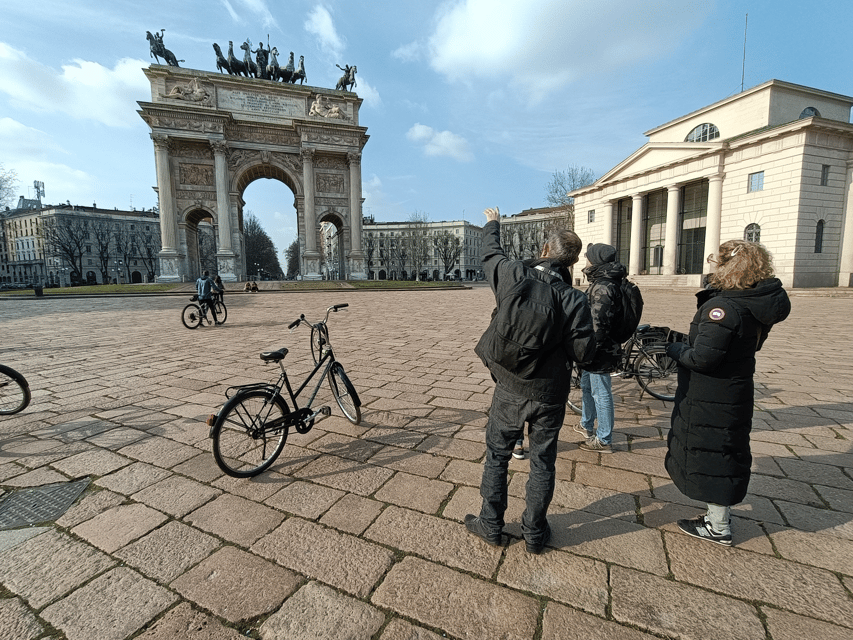
The Peace Arch gives you another strong photo opportunity and adds a different architectural mood after the castle. The route then reaches Darsena and the canals, where you stop to take pictures.
Darsena is useful as a change of pace. After monuments and formal squares, the water gives you a more open setting and a chance to see another side of Milan. You are not simply racing past it. The itinerary includes time for a short photo session, so keep your camera or phone easy to reach.
This is one of the places where a bike helps most. You can arrive without spending a long stretch on foot, pause for images, and then continue before the ride loses momentum. Bring a small camera or phone, but not a large bag, since luggage and large bags are not allowed.
Roman columns and the Basilica of Sant’Ambrogio
After Darsena, you get back on the bikes and head toward San Lorenzo and its Roman columns. These columns are among the clearest reminders that Milan is much older than its polished shopping streets and modern business areas.
The stop is short, but the setting helps you understand the city’s layers. Roman remains sit within the modern street plan, and the ride lets you see that contrast without turning the morning into a long archaeological lecture.
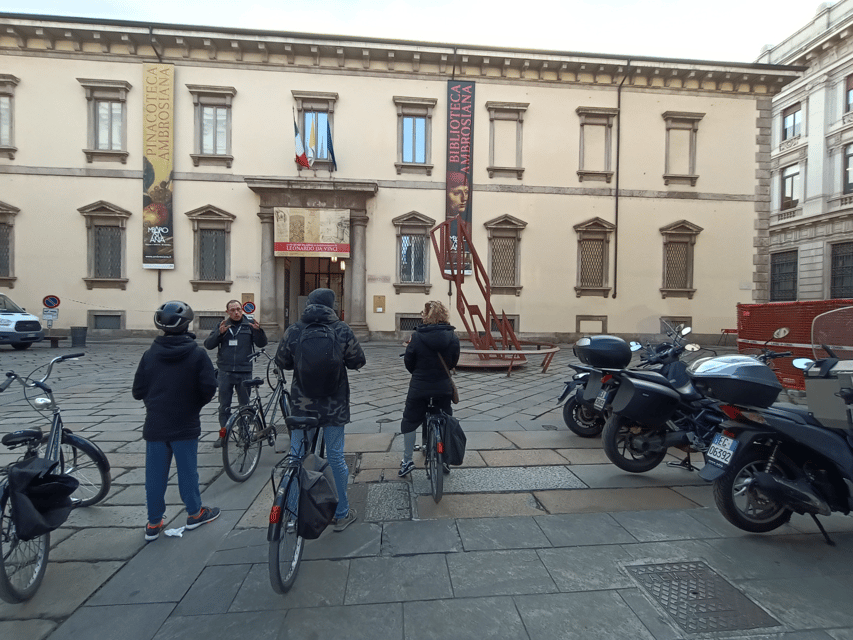
The route then continues to the Basilica of Sant’Ambrogio. The basilica is one of Milan’s key religious landmarks, and the stop adds a more local and historic note to the itinerary. With a guide, you can connect the church to the city’s wider story rather than treating it as another attractive facade.
You should expect explanations and viewing stops, not extended independent time at every monument. The tour covers a lot of ground. Its strength is the sequence: Roman remains, a major basilica, medieval and modern public spaces, then the center’s famous landmarks.
More bike tours around Italy:
- Rome EBike Tour: Appian Way, Catacombs & Roman Aqueducts
★ 5.0 · 1,766 reviews - Rome: Top Highlights & Hidden Gems Tour by Cannondale E-Bike
★ 4.9 · 1,760 reviews - Rome: Appian Way & Aqueducts E-Bike Tour (Catacombs & Food)
★ 4.9 · 1,498 reviews - Rome: Appian Way, Catacombs, & Roman Aqueducts E-bike Tour
★ 4.9 · 1,421 reviews
Via Brisa and Milan’s Roman remains
Via Brisa brings another archaeological detail into the ride. The Roman ruins here are easy to miss if you follow only the standard shopping and cathedral route.
I value this kind of stop because it gives you something to look for later. Milan can appear modern and business-focused at first glance, but the remains on Via Brisa make the city’s earlier layers visible. The guide’s explanation is important here because the ruins may not announce their importance to a passerby.
This section also shows the advantage of having a guide who can adjust the conversation. Emilio, in particular, is described as relaxed, highly informed about art and history, and good at shaping the discussion around the group’s questions. That is useful on a route with so many different periods and subjects.
Guide assignments can change, so do not assume Emilio or Katharine will lead every departure. Still, the experience has a strong record of guide-led storytelling, and the tour is offered in English or French.
Piazza Affari and L.O.V.E.
Piazza Affari gives the tour a sharp modern turn. This is Milan’s financial district, and the square is home to Maurizio Cattelan’s L.O.V.E. installation, the large hand sculpture better known by its nickname.
The stop is brief and designed for photographs. That works well here. You get the visual impact and the guide’s explanation without spending too much time in a square that may not otherwise fit into your Milan plans.
L.O.V.E. also gives the route a welcome change from churches and Roman ruins. Milan is a city of fashion, finance, design, and contemporary art, not only historic buildings. Putting the sculpture into the same ride as Sforza Castle and Sant’Ambrogio makes that point clearly.
As with the other stops, you should expect an exterior visit and a short explanation. This is not a museum tour or a dedicated contemporary-art walk. It is a well-chosen stop that adds variety to a broad city overview.
Mercanti Square, La Scala, and the Galleria
From Piazza Affari, the ride moves toward Mercanti Square and the central city. Mercanti Square provides a more intimate view of Milan’s historic civic center before the route opens onto La Scala Square.
La Scala is one of Milan’s most famous cultural landmarks. The cycling stop gives you a chance to see the exterior and hear about its place in the city. If you want to attend a performance or take a full interior tour, that requires a separate plan.
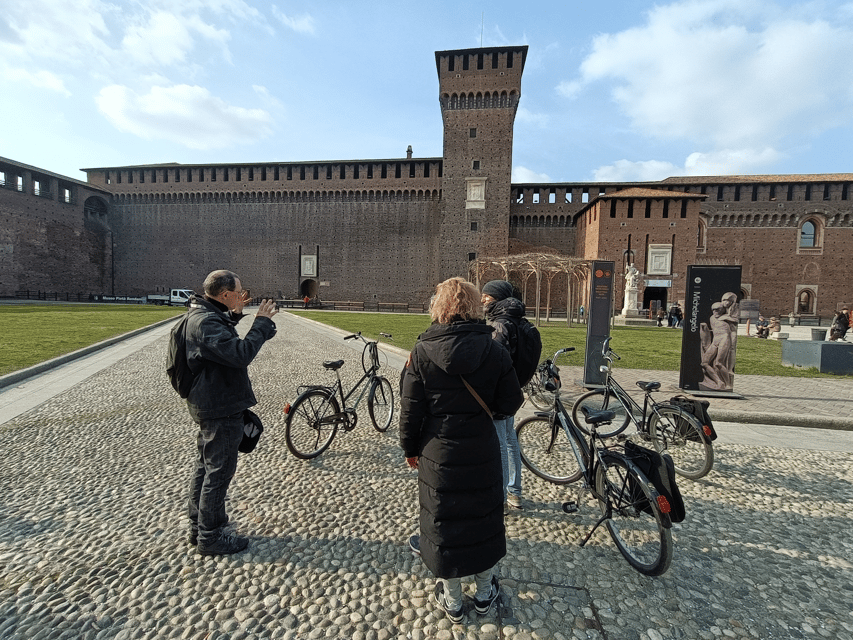
The next stop is Galleria Vittorio Emanuele II. Its grand glass roof, arches, and decorated floor make it one of the easiest places in Milan to recognize. The Galleria also connects naturally to the final stop at Piazza del Duomo.
A bicycle tour cannot give you the same lingering feel as a dedicated walking tour through these central spaces. You will likely deal with pedestrians and a busier city center here. The advantage is that you reach the sights efficiently and get a guide’s framing before deciding where to spend more time later.
Finishing at the Duomo
The final major stop is Duomo Square, with another short photo session before you return to the starting point. This is a fitting finish because the cathedral is Milan’s visual centerpiece and one of the city’s essential sights.
The Duomo stop is not a cathedral admission visit. You should not expect time on the rooftop or inside the church unless you arrange that separately. The benefit here is orientation: you see the square, understand where the cathedral sits in relation to the Galleria and La Scala, and leave with a clear sense of central Milan.
For first-time visitors, finishing at the Duomo is especially practical. You can return later for an interior visit, rooftop tickets, nearby shopping, or a meal in the center. The tour has done its job if it helps you choose how to use the rest of your stay.
The guides and the value of the commentary
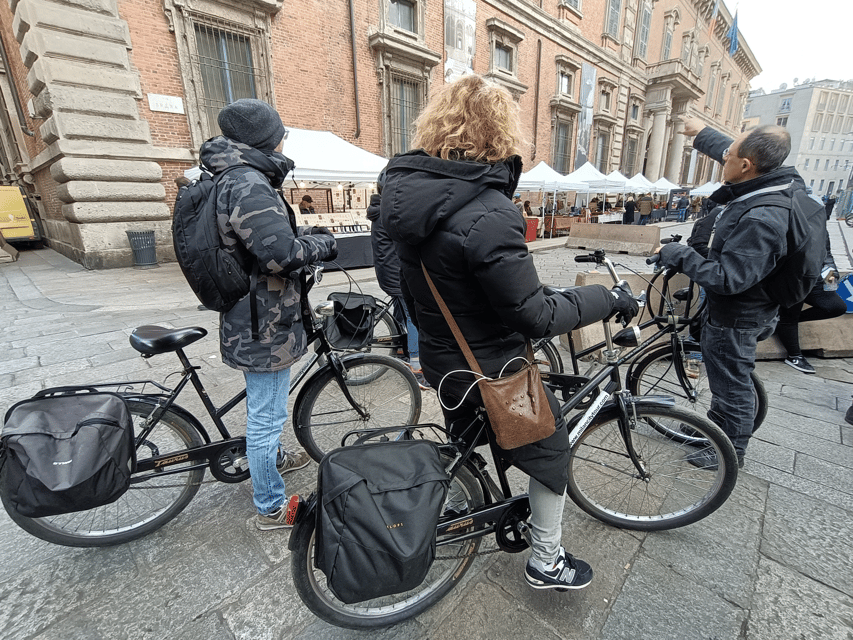
The strongest part of this experience is the guiding. Emilio is repeatedly described as a relaxed storyteller with a strong grasp of Milan’s art, history, and culture. He is also praised for answering questions and adapting the conversation to the people in the group.
Katharine is noted for giving clear historical and architectural explanations while keeping the ride comfortable. She is also described as allowing time at stops instead of rushing everyone back onto the bikes. Those details matter because a three-and-a-half-hour ride can feel hurried if every stop is treated as a quick glance.
The tour is available in English and French. If you care about language, confirm the available departure before booking. With no more than 10 participants, you should have a reasonable chance to ask about a building, artwork, or neighborhood as you go.
The guide cannot control every part of the experience. Weather, traffic, group ability, and city-center crowds can affect the pace. One booking took place in the rain and was still considered worthwhile, but wet conditions will naturally make cycling less comfortable.
Is $57 a fair price?
At $57 per person, the cost is reasonable for a 210-minute guided ride. The price includes the bicycle, helmet, and live guide, and the route covers many major Milan sights in one session.
The value is strongest if you want orientation and interpretation. You are paying to connect distant stops, learn what you are seeing, and avoid building your own route through the city. You are not paying for museum admissions, cathedral access, hotel transportation, food, or a private tour.
A walking tour may cost less in some cities, but it will not cover this much ground as comfortably. A private bike tour would give you more control, but this small-group version keeps the price lower while still limiting the group to 10.
Free cancellation up to 24 hours before the start gives you some flexibility, and you can reserve now and pay later. Those terms are useful when your Milan schedule is still changing.
Who should book this ride?
I would choose this tour for a first or second day in Milan, especially if you want a broad introduction before spending time inside the main sights. It suits active adults and older children who can ride comfortably and follow a group pace.
It is also a good fit if you enjoy history, architecture, and contemporary art in equal measure. The route moves from Roman columns to L.O.V.E. without treating Milan as only a cathedral city.
You should think twice if you want long interior visits, private attention, or a slow photographic tour. The ride is not suitable for pregnant women, people over 115 kilograms, unaccompanied minors, or anyone who may be intoxicated. Participants under 18 must be with a legal guardian.
Wear trainers or other comfortable shoes and clothing suitable for cycling. Leave large bags and luggage behind. Every participant needs an ID card and a copy of the payment or voucher when booked online.
Should you book the Milan guided bike tour?
Book it if you want to see a large part of central Milan in one well-organized outing, with a guide who can explain the links between Roman remains, churches, finance, contemporary art, and the Duomo. The small group, several photo stops, included bicycle and helmet, and strong guide feedback make the $57 price fair.
Skip it if your priority is spending hours inside Sforza Castle, Santa Maria delle Grazie, La Scala, or the Duomo. Those sights need separate admission plans and more time. For a practical first look at Milan, though, this is an efficient and enjoyable choice.
FAQ
How long does the Milan guided bike tour last?
The tour lasts 210 minutes, or three and a half hours.
What language is the tour offered in?
The live tour guide is available in English or French.
How many people are in the group?
The group is limited to 10 participants.
What is included in the price?
The price includes the tour guide, use of a bicycle, and a helmet.
Is hotel pickup included?
No. You must meet the guide at the Cargo bike store, and hotel pickup and drop-off are not included.
What should I bring?
Bring comfortable shoes, suitable clothing for cycling, an ID card, and a copy of your payment or voucher if you booked online.
Can children join the tour?
Participants under 18 must be accompanied by their legal guardian. Unaccompanied minors are not allowed.
Can I cancel the booking?
Yes. You can cancel up to 24 hours in advance for a full refund. You can also reserve now and pay later.
New rides added around Italy
- Porto Torres: rent a water bike★ 4.9 · 18 reviews
- Pisa: Self-Guided Bike Tour to Lucca★ 4.9 · 28 reviews
- Pisa: Historic Center Tour by Bike Self-Guided★ 4.4 · 68 reviews
- Pisa: Cycling to the Sea on a Self-Guided Tour★ 4.7 · 46 reviews
- Pisa: Self-Guided tour to the sea by E-Bike★ 4.9 · 45 reviews
- Peschiera del Garda: Lake Garda & Borghetto E-Bike Tour★ 5.0 · 23 reviews
- Palermo: Anti-mafia Bike Tour★ 4.9 · 28 reviews
- Palermo: Historic Center Guided Bike Tour with Food Tasting★ 4.7 · 85 reviews
Milan Bike Tours, compared.
Milan’s Hidden Gems: Unique Bike Tour (ENG, NL)
Read our review →
Browse the lists this tour appears in